High-Functioning Anxiety: When you look fine but your nervous system isn't
Do you look calm and capable on the outside while your nervous system is quietly overwhelmed on the inside? Explore what high-functioning anxiety really is, why it so often goes unnoticed, and how somatic, nervous-system-based tools can help you feel as okay as you look.
Table of contents
- Introduction
- What is high-functioning anxiety?
- Why it's so easy to miss, even in yourself
- What's actually happening in your nervous system
- Why "just relax" doesn't work
- Feeling what's underneath: pendulation and titration
- Somatic tools for high-functioning anxiety
- How to help someone with high-functioning anxiety
- How Somatic Self Healing can help
- References
Introduction
Have you ever been told you seem so calm, so on top of things, so put together, while inside you're holding on by a thread?
That's the strange, quiet loneliness of high-functioning anxiety. From the outside, everything looks fine; you're getting the emails sent, the kids to school, the deadlines met, and maybe you're even the person others come to when they're struggling. But underneath the achieving and the doing, your body is working overtime just to keep you upright.
I hear this from so many people I work with, and honestly, I've lived a version of it myself. The anxiety doesn't always look like panic or falling apart; sometimes it looks like never quite switching off, always being one step ahead of disaster, or feeling like you can't stop until everything is done.
In this article I want to explore what high-functioning anxiety actually is, why it so often slips under the radar (even for the person experiencing it), what's happening in the nervous system underneath all that capability, and what actually helps, beyond just "trying to relax."
What is high-functioning anxiety?
High-functioning anxiety isn't a clinical diagnosis; you won't find it in the DSMThe Diagnostic and Statistical Manual of Mental Disorders, the standard classification of mental health conditions used by clinicians.. But it's an incredibly common lived experience, and one that seems to be getting more and more common as modern life demands so much of us.
It describes anxiety that exists alongside outward success and competence, rather than instead of it. You can be anxious and still be capable; in fact, for many people, the anxiety is part of what drives the capability. It often looks like overpreparing for everything just in case, struggling to rest even when there's nothing urgent to do, a racing mind that won't quiet down at night, people-pleasing or over-apologising to avoid conflict, a persistent sense that something bad is about to happen even when life is objectively fine, and perfectionism that feels less like ambition and more like self-protection.
None of this necessarily stops you from functioning, and that's exactly the problem. Because it doesn't stop you, it often goes unnamed, unnoticed and unsupported for years.
I think this is the really sad part of it. So many people are carrying this burden, especially those in their 20s, 30s and 40s (though it can affect any age), because we're juggling trying to keep on top of our personal finances, afford a home, keep down a job, get promoted, be a good parent, and look after elderly parents, all in a world that feels more and more fragile against a backdrop of geopolitical tension and climate disasters. We're still not at a place where people can openly talk about how they feel inside, and so it's almost inevitable that this mix creates a pressure chamber, one that so many of us just keep pushing through.
I think about the parent working full time while juggling the school run, childcare, and caring for their own ageing parents. I think about the person who's taken on a bigger role, and a bigger mortgage to go with it, all while still trying to be the fun one, the present one, at the weekend. I think about all of us quietly trying to tick off the list we've been told we should be keeping: exercise, home-cooked meals, saving for a house, climbing the career ladder, being endlessly available. No wonder our nervous systems are exhausted.
Why it's so easy to miss, even in yourself
We tend to think of anxiety as something noticeable, like a panic attack, an inability to leave the house, or shaky hands, breath or voice. High-functioning anxiety rarely looks like that.
Instead, it hides inside things our culture actually rewards: being switched on, being reliable, being the one who copes. Nobody questions the person who's always early, always prepared, always managing; if anything, they get praised for it.
So the anxiety gets mistaken for personality. "I'm just a perfectionist." "I'm just a planner." "I just like being organised." Sometimes that's true, but sometimes it's a nervous system that has learned it isn't safe to slow down, so it keeps you moving instead.
This is one of the reasons high-functioning anxiety can be so hard to catch. You don't get the external permission to struggle that a more visible crisis might bring, because there's no obvious crisis; you're doing fine, everyone says so, and that can leave you wondering whether you're allowed to feel as tired and wired as you actually feel.
What's actually happening in your nervous system
High-functioning anxiety usually reflects a nervous system that has spent a long time living in a low-grade sympathetic nervous systemThe branch of the autonomic nervous system responsible for mobilising the body towards action, often described as fight or flight. state (Porges, 2011), not the full-blown fight-or-flight of a genuine emergency, but a steady hum of activation underneath everything else.
This state is brilliant at getting things done; it sharpens focus, keeps you scanning for problems before they happen, and rewards you with a sense of control every time you tick something off the list. The trouble is, it was never designed to run constantly.
When the sympathetic nervous system stays switched on for long periods, whether from childhood experiences, chronic stress, trauma, or simply years of having to hold things together, your body can start to treat that activated state as the new normal (van der Kolk, 2015). Rest can start to feel unfamiliar, even unsafe, because slowing down means your body finally has space to notice everything it's been holding.
This is often why people with high-functioning anxiety find it easier to keep going than to stop; stopping is when the feelings catch up. If you'd like to understand this pattern in more depth, you may find it helpful to read my articles on the fight or flight response and the Window of Tolerance, which explain why chronic activation narrows how much a nervous system can comfortably hold before it tips into survival states.
Why "just relax" doesn't work
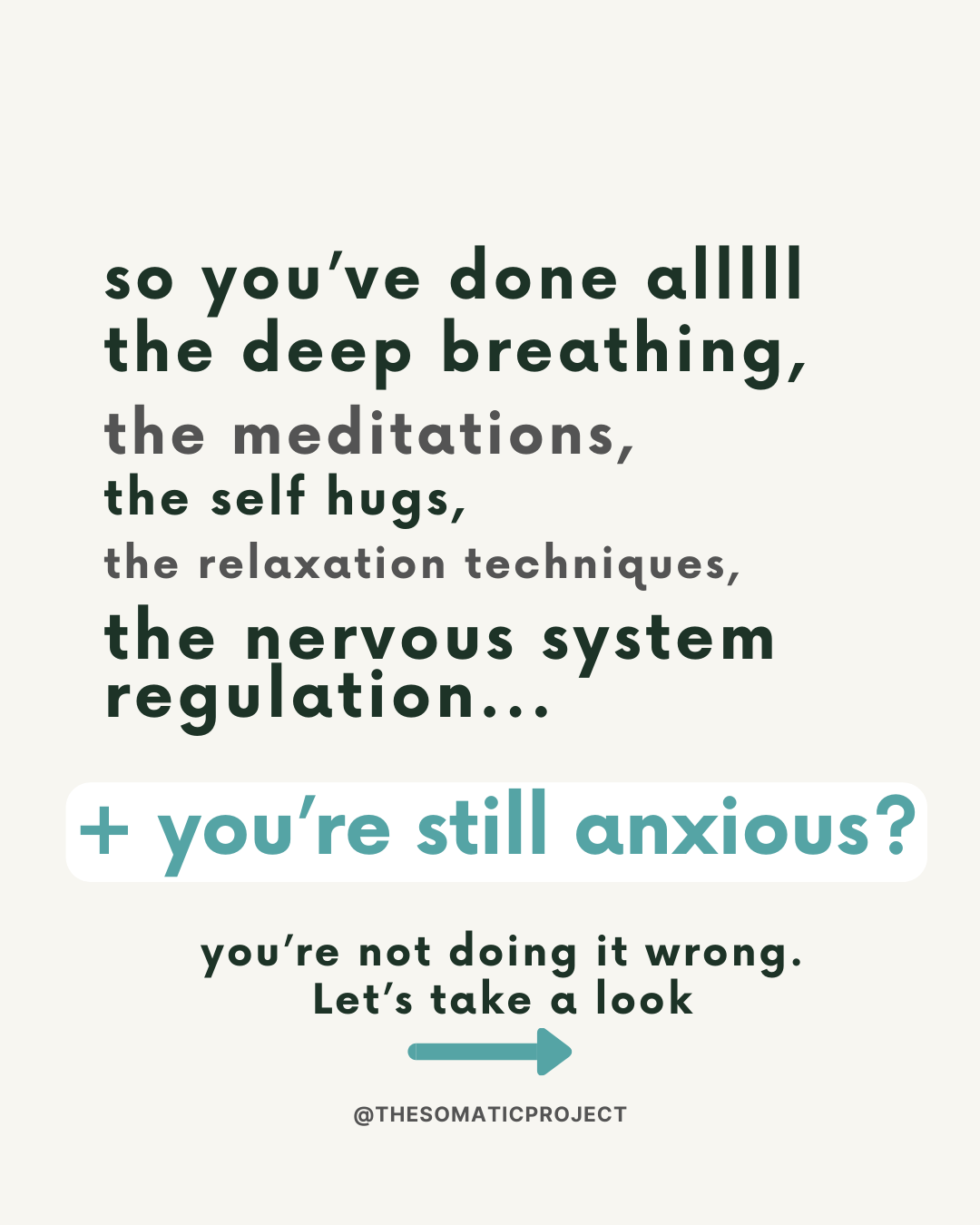
If you've ever been told to relax, breathe, or stop overthinking, and felt a flash of frustration rather than calm, you're not alone, and you're not doing it wrong.
Telling an activated nervous system to relax is a bit like telling a smoke alarm to stop beeping while the room is still full of smoke; the alarm isn't the problem, it's responding to something. Until your body receives real evidence of safety, rather than just an instruction to feel calm, it will keep doing its job.
This is why willpower alone rarely resolves high-functioning anxiety, and if that idea resonates, it's worth reading my article on why you can't think your way out of anxiety, which goes into this in more depth. What actually helps is giving the body different information, gently and repeatedly, so it can learn a new baseline over time (Dana, 2018).
Feeling what's underneath: pendulation and titration
Underneath high-functioning anxiety, there's usually a lot of feeling that hasn't been allowed to move. All that overpreparing, overperforming and staying one step ahead is often standing in for something the body hasn't had the chance to properly feel. That low-grade sympathetic activation isn't random; it's often energy from a fight, flight or fawn response that never fully completed, still quietly asking to be acknowledged rather than managed around (Levine, 1997).
This is where pendulationA somatic technique of gently moving attention back and forth between a difficult sensation and a felt sense of safety or resource, so the nervous system learns it can touch what's hard and return to safety again. and titrationWorking with only a small, manageable piece of activation or emotion at a time, rather than the whole thing at once, so the nervous system isn't overwhelmed by what it's processing. come in. Rather than diving straight into whatever feels difficult, pendulation lets you gently move between a felt sense of activation and a felt sense of safety, so your nervous system learns, in small doses, that it's safe to feel. Titration keeps that process gentle and manageable, working with a small piece of what's there rather than all of it at once.
Once there's a little more capacity, gentle somatic techniques can help your body actually process what your nervous system may have been holding onto as a survival strategy. Shaking the body can help discharge stored fight-or-flight energy that was never able to complete. Using your voice, whether that's sound, a growl, or a firm "no," can give expression to anger that's had nowhere to go. Pushing against something solid, a wall, a cushion, or resistance from another person's hands, can help your body practise and actually feel a boundary it may never have been allowed to assert.
Many people find that once they've done this kind of processing, even in small, titrated doses, they're much better able to switch off, to say no, and to allow themselves the downtime they need to recover in between life's many asks.
This is exactly what Somatic Self Healing gently guides you through. You'll learn how to feel it to heal it, in a safe and structured way.
Somatic tools for high-functioning anxiety
The good news is that because high-functioning anxiety lives in the body as much as the mind, it responds well to body-based practices. A few places to start:
Build in deliberate pauses, not just breaks.
A break where you're still scrolling or planning isn't a nervous system reset; try short, screen-free pauses where you simply notice your breath or your feet on the floor for sixty seconds. The free practices in my five-day journey could help you build this habit.
Practice slow exhales.
A longer exhale than inhale (four counts in, six to eight counts out) signals safety to your vagus nerve and gently shifts you out of sympathetic activation (Brown and Gerbarg, 2005). In Module 2 of Somatic Self Healing you'll learn all about the science of breathwork, so you can understand how to harness the power of your breath as and when you need it.
Notice your baseline tension.
Many people with high-functioning anxiety carry chronic tension in the jaw, shoulders or stomach without realising it; a few times a day, pause and ask what your body is doing right now, without trying to change it yet. My guide to somatic self holds offers some simple, supportive ways to respond once you notice it. Somatic Self Healing helps you identify and work with tension patterns that show up in your muscles and posture, and gently guides you through safe, supportive ways to release this.
Let rest be boring sometimes.
If rest has to be productive, it doesn't fully register as rest to your nervous system; practising genuinely unstructured downtime, even briefly, teaches your body it's allowed.
Get curious rather than critical.
Instead of "why can't I just relax," try "what is my nervous system trying to protect me from right now." If you're new to this way of understanding your nervous system, my article on nervous system regulation is a helpful place to start.
How to help someone with high-functioning anxiety
If someone you love seems like they're managing everything, but you sense there's more going on underneath, there's a lot you can do without needing to fix it. Notice out loud, gently, without diagnosing; something as simple as "you've had a lot on lately" can mean more than you'd think, because it lets someone know they've been seen without demanding they explain themselves.
Try to resist the urge to just tell them to relax or slow down. As we've seen, that rarely helps, and can leave someone feeling even more alone in it. Instead, try asking what would actually feel supportive right now, rather than assuming you already know. Sometimes the most helpful thing is simply making space, without an agenda, and letting them arrive at what they need in their own time.
Try not to praise the busyness or the coping itself; celebrate the moments they do rest, say no, or ask for help instead. And if you can, model that yourself. Let them see you resting, setting a boundary, or admitting you're not okay, because sometimes permission is contagious.
How Somatic Self Healing can help
High-functioning anxiety often develops as a genuinely intelligent, protective strategy, and it makes complete sense that it doesn't disappear just because someone points it out; real change happens through repeated experiences of safety, not a single insight.
That's exactly what Somatic Self Healing is built to support. Through gentle, trauma-informed nervous system education and practice, you'll learn to recognise your own patterns of activation, build genuine capacity for rest, and slowly teach your body that it's safe to put some of that vigilance down.
You don't have to keep proving you're okay. You're allowed to actually feel okay too.

References
- Brown, R. P. and Gerbarg, P. L. (2005) 'Sudarshan Kriya yogic breathing in the treatment of stress, anxiety, and depression: Part I, neurophysiologic model', Journal of Alternative and Complementary Medicine, 11(1), pp. 189-201.
- Dana, D. (2018) The Polyvagal Theory in Therapy: Engaging the Rhythm of Regulation. New York: W. W. Norton.
- Levine, P. A. (1997) Waking the Tiger: Healing Trauma. Berkeley, CA: North Atlantic Books.
- Porges, S. W. (2011) The Polyvagal Theory: Neurophysiological Foundations of Emotions, Attachment, Communication, and Self-Regulation. New York: W. W. Norton.
- van der Kolk, B. A. (2015) The Body Keeps the Score: Mind, Brain and Body in the Transformation of Trauma. New York: Viking.