Why saying no feels so hard: Healing the people pleasing response
Do you say yes before you've even worked out if you mean it, or find yourself apologising for things that were never your fault? Here's why people-pleasing runs so much deeper than personality, and the somatic tools that can help you find your own voice again.
Table of contents
Introduction
Do you find yourself agreeing to plans you don't really want to make, or hear yourself say "honestly, it's fine" when it really isn't? Maybe you've caught yourself apologising for something that was never your fault in the first place, almost before the other person has finished their sentence.
If either of those feels familiar, you already know what it's like to quietly override your own needs to keep things comfortable for someone else, even if you've never had a word for it or understand your why.
This is a pattern I know well myself; from my own personal experiences and from working alongside many others - learning, slowly, that "no" is allowed to exist again is a very important part of our healing. In this article I want to explore what's actually happening in your nervous system when disappointing someone feels almost dangerous, where the word "fawning" fits into that, and the somatic practices, including some straight from inside Somatic Self Healing, that can help you build a steadier sense of your own boundaries.
This has a name: fawning
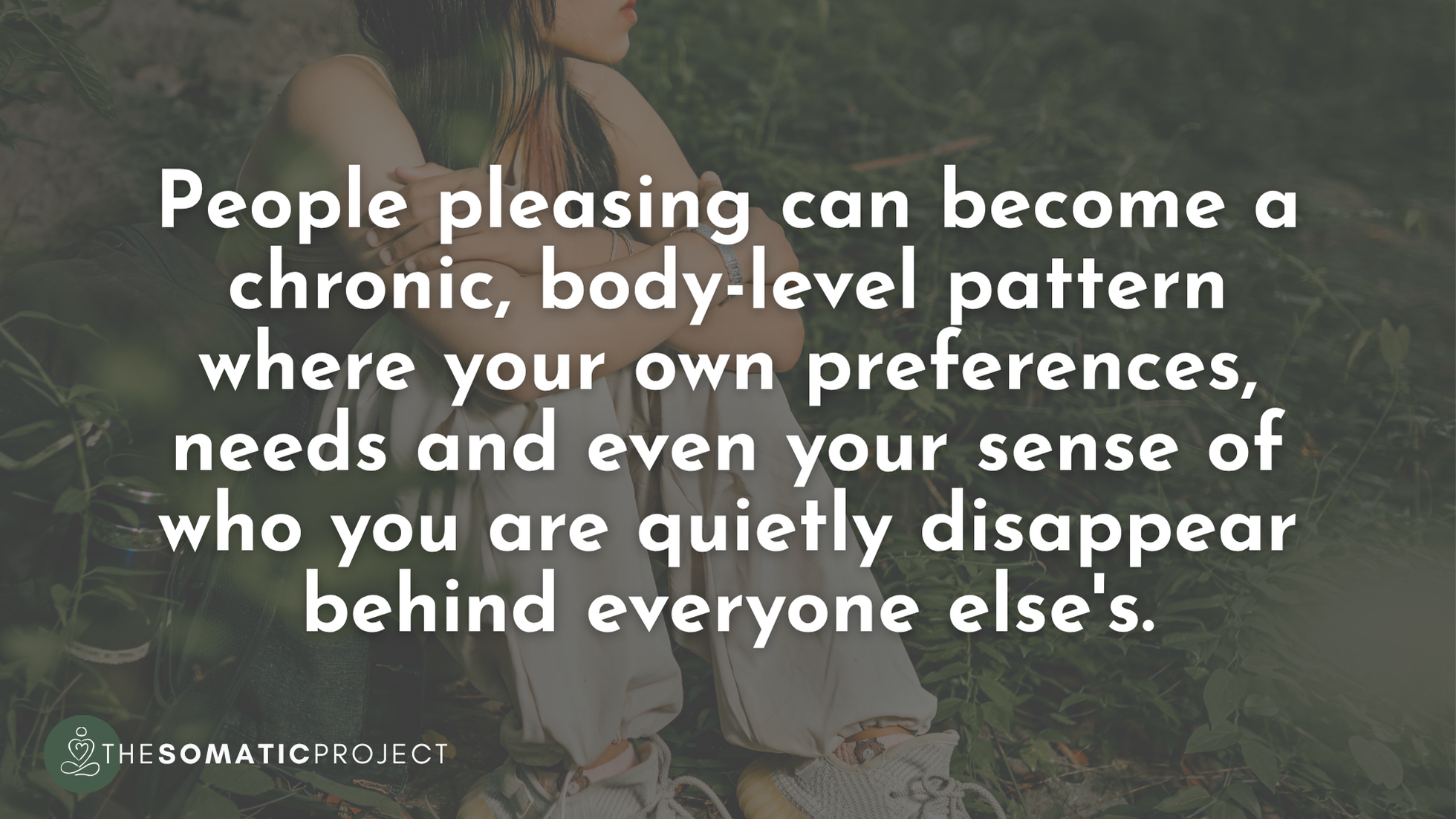
What I've just described has a name in trauma theory: the fawn responseA trauma response where the nervous system moves toward appeasing, pleasing or accommodating a perceived threat, rather than fighting, fleeing or freezing., sometimes described as a fourth survival response alongside fight, flight and freeze (Walker, 2013). I want to be careful with that word, because people-pleasing sits on a spectrum. At one end, it's simply being a kind, considerate person, and there's nothing wrong with that. Further along, it can become a chronic, body-level pattern where your own preferences, needs and even your sense of who you are quietly disappear behind everyone else's.
Fawning isn't a personality flaw, and it isn't something you're doing on purpose. Pete Walker, who first named the pattern, described it as developing most often in relationships where fighting or fleeing wasn't safe or possible, so the nervous system learned that becoming agreeable, helpful or even invisible was the safer way through (Walker, 2013). It's a genuinely intelligent survival strategy, even when what it costs you is your own voice.
Why your nervous system fawns
If you've read my article on freeze and shutdown, fawning will feel like a close cousin; it often blends with a freeze response, and it also borrows something from your ventral vagal systemPart of the parasympathetic nervous system linked to safety and social connection, sometimes called the social engagement system., the part of your nervous system built for connection (Porges, 2011). Under threat, that same connection-seeking wiring can get hijacked into appeasement: if I can make you calm, if I can make you like me, then maybe I'll be safe.
This often has roots in childhood or in relationships where love or safety felt conditional on being easy, agreeable or undemanding. If conflict felt genuinely dangerous, or if someone else's mood set the emotional temperature of the whole household, your nervous system may have learned that keeping others comfortable was the safest job available to you (van der Kolk, 2014). Over time, that strategy can generalise well beyond where it started, until pleasing people becomes the automatic response to almost any hint of tension, long after the original relationship has changed or ended.
Your body found a way to stay safe in relationships that needed you to be small. It makes complete sense that it's still trying to keep you safe now, even if the situation has changed.
What this can look like day to day
Fawning rarely announces itself as fawning. It tends to hide inside things we might otherwise put down to being "easygoing" or "nice" or "chilled". You might recognise some of these:
- Saying yes when you mean no, and only noticing the resentment afterwards.
- Apologising for things that aren't your fault, almost automatically.
- Struggling to know what you actually want, because you're so used to noticing what everyone else wants first.
- A tight, anxious feeling in your chest or stomach the moment someone seems even slightly annoyed with you.
- Feeling responsible for managing other people's emotions, at the cost of your own.
- Feeling wiped out after socialising, from the effort of staying agreeable the whole time.
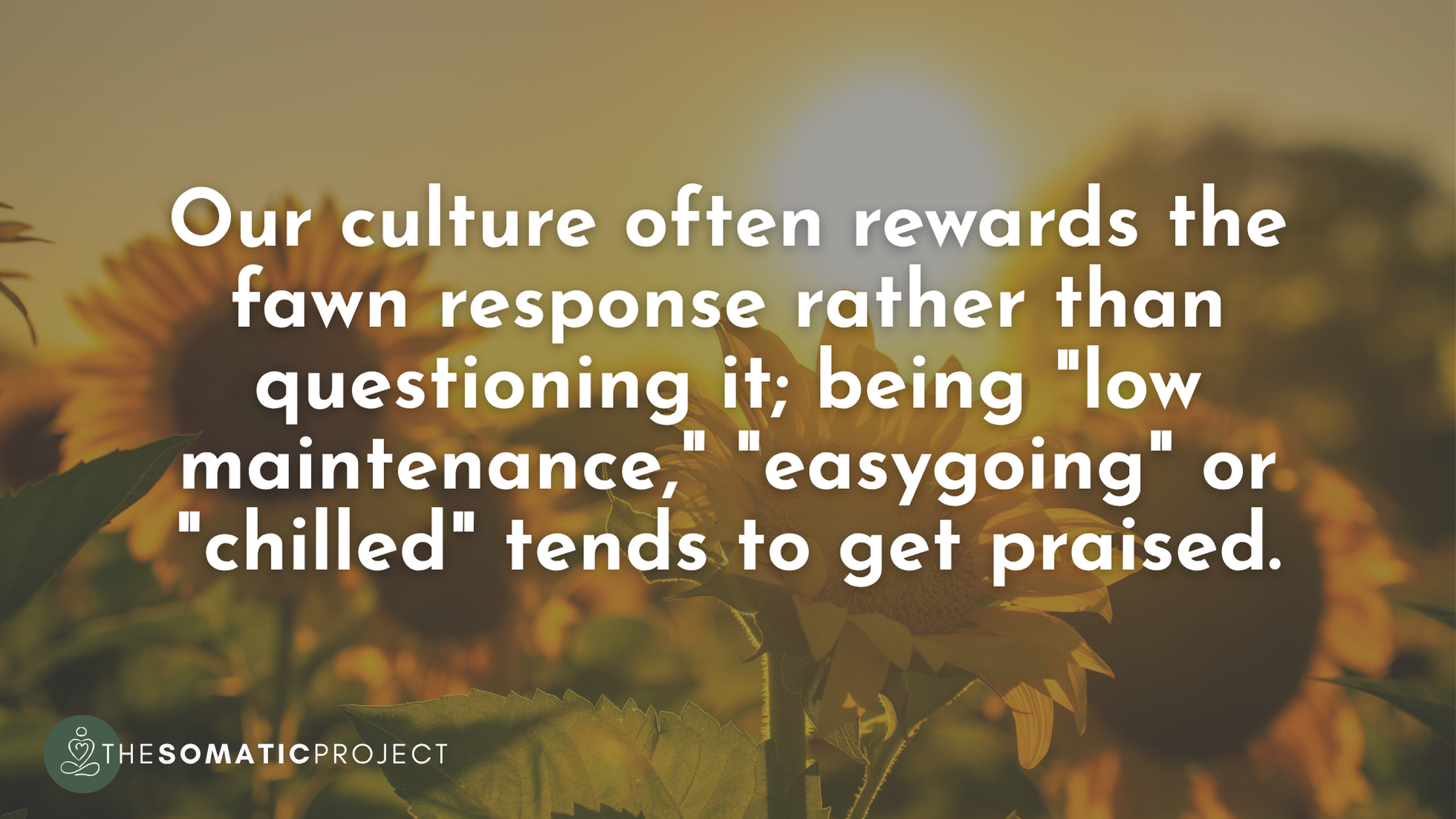
It's worth saying that our culture often rewards this pattern rather than questioning it; being "low maintenance," "easygoing" or "chilled" tends to get praised, which can make it even harder to notice you've been fawning at all, let alone that it's costing you something.
Why "just say no" doesn't work
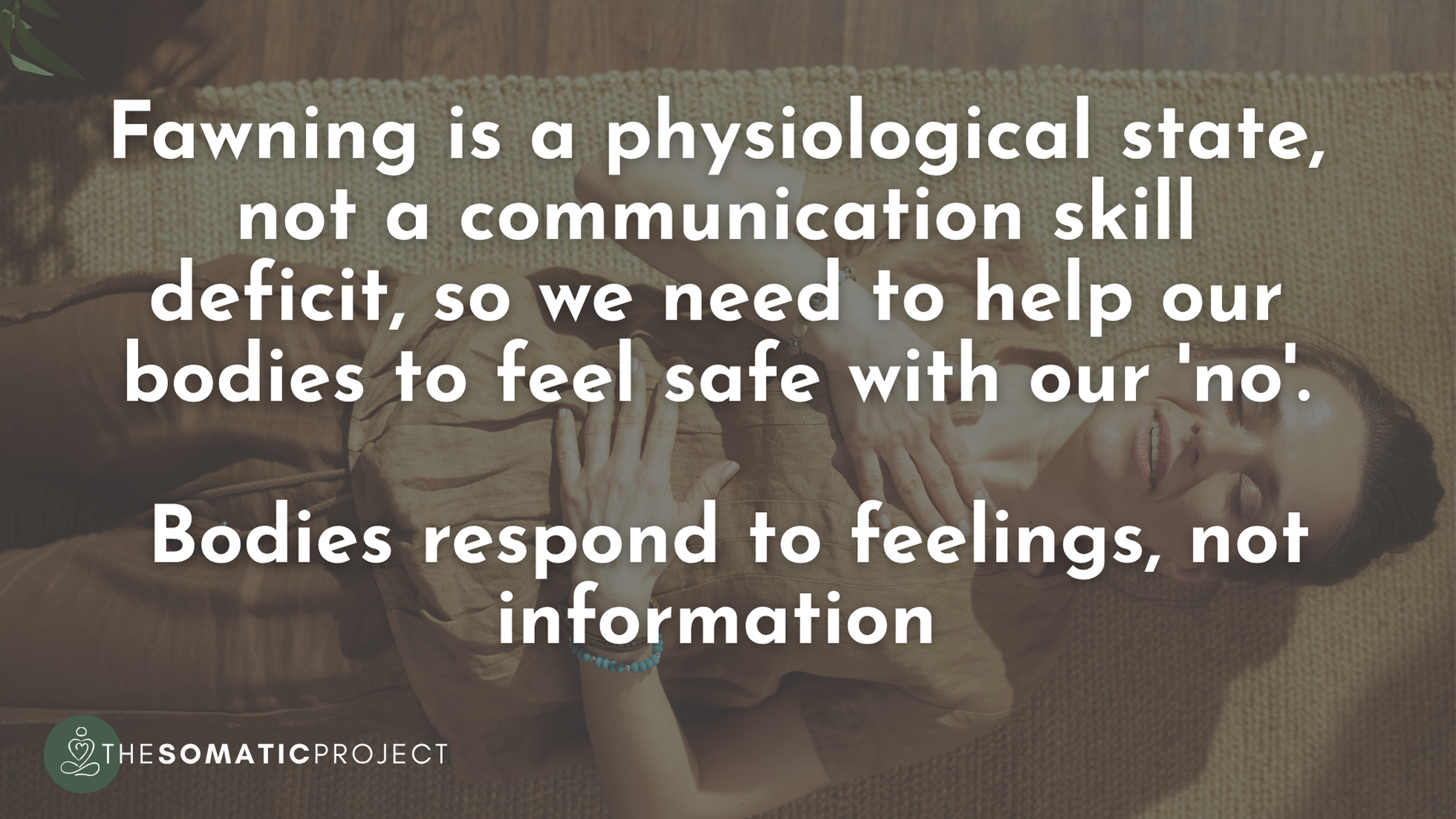
If you've ever tried to practcie saying no, and then still frozen the moment you actually needed to, that's not a failure of willpower or knowledge. Fawning is a physiological state, not a communication skill deficit, so we need to be working with our body as much as our mind, to help ourselves feel safe with our 'no'; Bodies respond to feelings, not information (Ogden, Minton and Pain, 2006).
This is why simply deciding to "just say no" rarely works on its own, and can leave you feeling ashamed on top of already feeling overwhelmed. What actually helps is building your nervous system's capacity to tolerate the uncomfortable feelings of saying no, and coping with someone else's disappointment without collapsing into appeasement, one small, safe experience at a time.
Practices that actually help
Healing a fawn response isn't about becoming a different, more assertive personal overnight. It's about slowly teaching your nervous system that your own needs and your own "no" can exist safely alongside connection with other people. A few places this work can start:
Notice the fawn reflex as it's happening.
The first stage of healing the fawn response is noticing and acknowledge it - we can't change what we aren't aware of, and these automatic responses often happen underneath our level of conscious awareness...In Somatic Self Healing you're walked through the process of 'Meeting your Fawn Response' which helps you to notice the types of thoughts, feelings, sensations and behaviours that arise when fawn wakes up. When you recognise that reflex earlier, you can start to have a genuine choice about what to do next, rather than an automatic reaction.
Meet your inner people-pleaser with curiosity, not criticism.
Whilst getting to know the fawning part of you, its really important to meet it with curiosity, not shame or criticism. Somatic parts work, inspired by Internal Family Systems (Schwartz, 1995), invites you to relate to the part of you that fawns as a protector rather than a flaw - this helps you to turn towards the response, so we can work with it, instead of trying to hide or block it. Module 7's Meeting a Part for the First Time practice offers a gentle way to start that relationship, so healing feels like befriending yourself rather than fighting yourself.
Reconnect with your sense of boundary.
Before you can hold a boundary in conversation, it often helps to feel one in your body. In Somatic Self Healing, practices like Reasserting Physical Boundaries and Reclaiming Our Energetic Boundaries in Module 6 use gentle, embodied exercises to help you feel where you end and someone else begins, so a boundary becomes a felt sense rather than just an idea. To give you a taste of what the practices in Somatic Self Healing are like, and to help you get started with some somatic boundary work to heal your fawn response, here is the full video of Reclaiming Our Energetic Boundaries.
When we’ve experienced boundary ruptures or lived in fawn, freeze or dissociative states, we can lose touch with our own edges; not just physically, but emotionally and relationally too. This practice helps you reconnect with your energetic boundary: the space around your body that belongs to you. It’s not about building walls, but cultivating a felt sense of “this is me, and this is not me.”
By reconnecting to this invisible yet powerful layer of self, we begin to restore agency, safety and clarity in relationship.
Reclaiming energetic boundaries — video practice
When more support is needed
These practices are genuinely helpful for everyday people-pleasing, but it's worth being honest that they aren't always enough on their own, and that's okay. If fawning feels tied to a difficult or complex relational history or traumas, particularly from childhood, please be gentle with yourself and consider reaching out to a trained trauma therapist alongside any somatic work you do; some experiences deserve more support than a self-guided article or programme can offer, and there's real strength in asking for it.
If you'd like to understand more about the wider states your nervous system moves through, my articles on freeze and shutdown and the Window of Tolerance may be helpful companions to this one.
How Somatic Self Healing can help
Fawning often develops because, at some point, your body genuinely needed a way to stay safe in a relationship where being agreeable felt like the only option. It makes complete sense that it doesn't just switch off because you understand it intellectually; real change comes through repeated experiences of feeling safe enough to have your own needs, built slowly and gently, not through insight alone.
That's exactly what Somatic Self Healing is built to support. Through body awareness, boundary work, parts work and gentle nervous system education, you'll learn to recognise the fawn reflex, build a felt sense of your own boundaries, and slowly reclaim the parts of yourself that got quietened to keep everyone else comfortable.
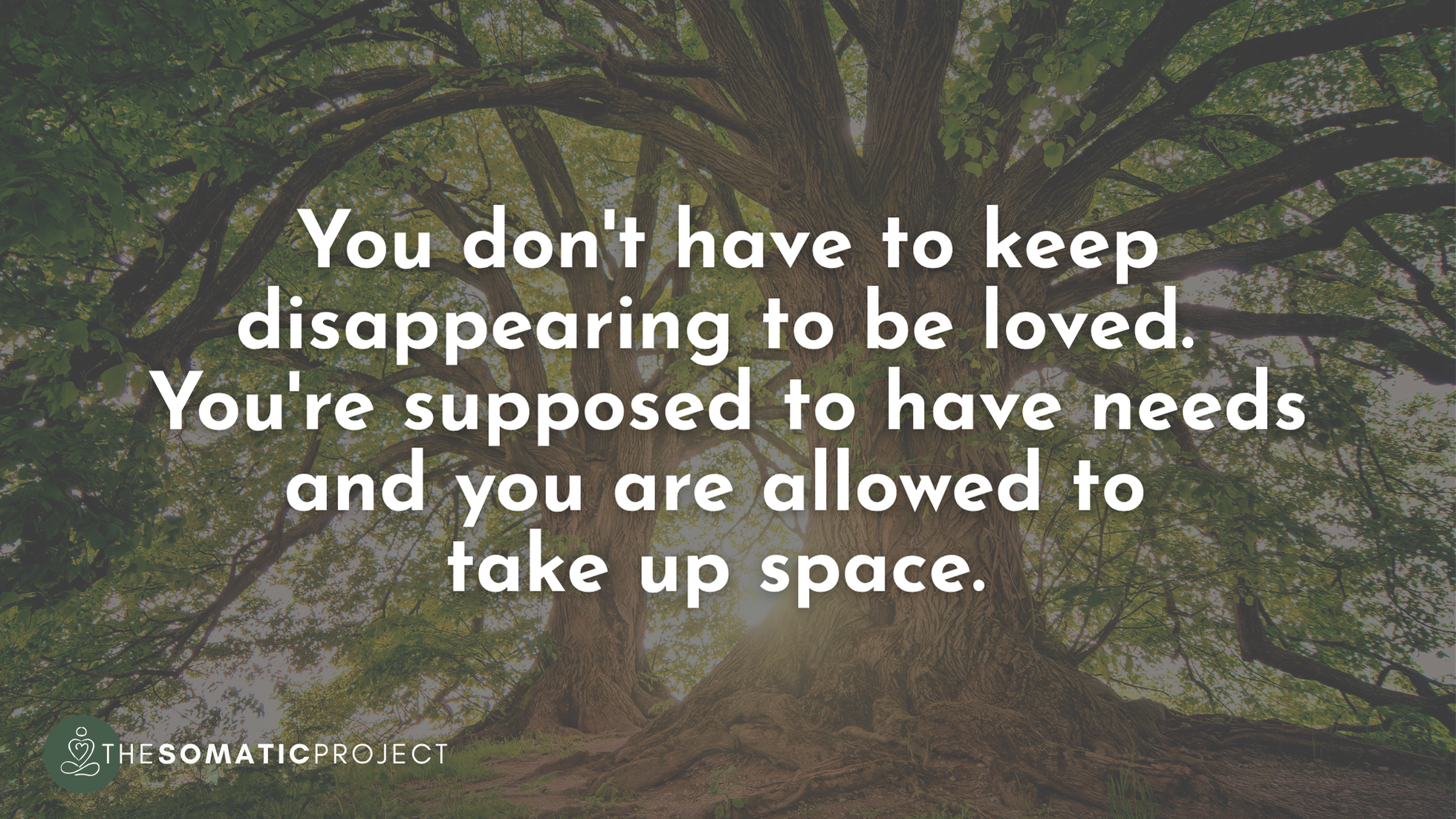
You don't have to keep disappearing to be loved. You're supposed to have needs and you are allowed to take up space.
References
- Ogden, P., Minton, K. and Pain, C. (2006) Trauma and the Body: A Sensorimotor Approach to Psychotherapy. New York: W. W. Norton.
- Porges, S. W. (2011) The Polyvagal Theory: Neurophysiological Foundations of Emotions, Attachment, Communication, and Self-Regulation. New York: W. W. Norton.
- Schwartz, R. C. (1995) Internal Family Systems Therapy. New York: Guilford Press.
- van der Kolk, B. A. (2014) The Body Keeps the Score: Brain, Mind and Body in the Healing of Trauma. New York: Viking.
- Walker, P. (2013) Complex PTSD: From Surviving to Thriving: A Guide and Map for Recovering from Childhood Trauma. Lafayette, CA: Azure Coyote Publishing.