Grounding Techniques: What to do when you feel disconnected from your body
Do you ever feel like you're going through the motions of your own life without quite being in it? Not sure what you're feeling, or feeling nothing at all? Here's what's actually going on when you feel disconnected from your body, and the grounding techniques that can gently help you come back.
Table of contents
Introduction
Do you ever nod along in a conversation while some part of you feels like it's left the room? Or reach the end of a meal and realise you didn't taste a single bite of it?
Maybe someone asks how you're feeling and you genuinely don't know, not because you're avoiding the question, but because you've stopped being able to feel much of anything. Maybe you've caught your own reflection and felt oddly far away from the person looking back. Maybe you move through entire days on a kind of autopilot; present in your body, but not really there.
If any of that sounds familiar, you already know what it feels like to be disconnected from your body, even if you've never had a word for it.
I think this kind of disconnection is one of the most misunderstood nervous system states, exactly because it's so quiet. People often imagine something dramatic when they hear the word "dissociation," but for so many of us it's subtle and everyday; easy to mistake for tiredness, distraction, or just "being a bit spacey." I've had my own periods of feeling far away from myself, especially during the most overwhelming chapters of my life, and I remember how disorientating it was before I understood what my body was actually doing.
In this article I want to explore what it really means to feel disconnected from your body, where the word dissociation fits into that, why your nervous system does it, and the grounding techniques that can gently, safely help you feel more present and connected again.
This has a name: dissociation
What I've just described has a clinical name: dissociationA protective disconnection from thoughts, feelings, body sensations or surroundings, ranging from mild everyday disconnection to more significant detachment from reality.. I want to be careful with that word, because it covers a genuinely wide range, and I don't want to make it sound like it's the same thing as an ordinary daydream, or trivialise what can, for some people, be a much bigger part of their story.
At the milder end, it's the motorway hypnosis, the losing-half-an-hour-to-your-phone kind of everyday disconnection almost everyone experiences sometimes. Further along, it can look like depersonalisationA sense of being detached from your own body, thoughts or emotions, as though observing yourself from the outside., feeling like you're watching yourself from outside your body, or derealisationA sense that the world around you feels unreal, distant, foggy or dreamlike., where the world around you feels unreal, muffled or far away (Nijenhuis and van der Hart, 2011). For some people, this kind of disconnection is closely tied to a significant trauma history and deserves proper therapeutic support alongside anything you read here; I'll come back to that later in the article.
Wherever you sit on that spectrum, dissociation isn't a character flaw or a sign that something is broken in you. It's a genuinely intelligent survival strategy; when a situation feels too overwhelming to fully feel, and neither fighting nor fleeing feels possible, the nervous system's next move is often to create distance. Van der Hart, Nijenhuis and Steele (2006) describe this as a kind of structural splitting, where parts of the personality organise around getting on with daily life while other parts hold what felt too much to feel at the time. You don't choose it, and you can't simply decide your way out of it; it's your body doing exactly what it learned to do to protect you.
Why your nervous system disconnects
If you've read my article on freeze and shutdown, this will feel like familiar territory. Disconnection like this tends to live in that same low, dorsal vagal shutdown state; a very old, very protective part of the nervous system that pulls energy inward when escape or defence doesn't feel possible (Porges, 2011).
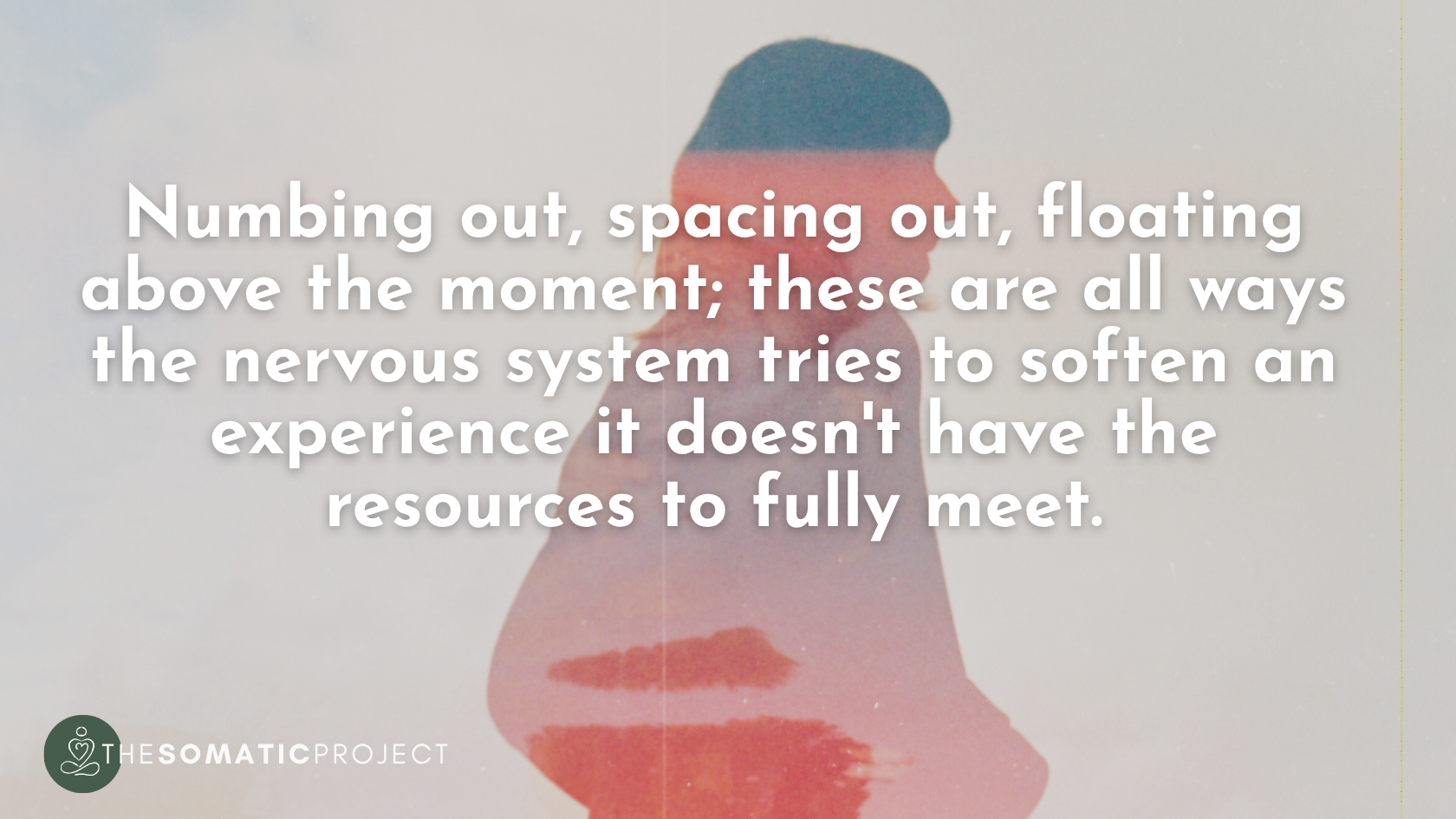
Think of it as your body's last line of defence. Fight and flight ask "can I get away from this?" Disconnection asks something quieter and sadder: "if I can't get away, can I at least get away from feeling it?" Numbing out, spacing out, floating above the moment; these are all ways the nervous system tries to soften an experience it doesn't have the resources to fully meet.
This is why it so often has roots in childhood, in relationships, or in situations that went on for a long time rather than a single frightening moment. If you couldn't run and couldn't fight, whether because you were small, because the danger was a person you depended on, or because it simply wasn't safe to react, your nervous system may have learned that leaving internally was the safest option available. Over time, that strategy can become the body's default response to anything that feels even mildly too much, long after the original situation has passed (van der Kolk, 2014).
I don't think that's something to be ashamed of. I think it's something to be genuinely moved by, that your body found a way to help you survive, even when the cost was feeling far away from your own life.
What this can look like day to day
This kind of disconnection rarely announces itself. It tends to hide inside things we might otherwise put down to being busy, tired or "just how I am." You might recognise some of these:
- Feeling numb, or not sure what you're feeling at all, even in moments that should matter to you.
- Moving through your day on autopilot; present in your body, but not really there.
- Struggling to feel present with people you love, even when you want to be.
- A sense that your body feels far away, unfamiliar, or not quite yours.
- Not noticing you're hungry, tired, overwhelmed or in pain until it's extreme, because you've stopped tracking the signal.
- Losing time; realising an hour has disappeared while you were scrolling or staring at a wall, or arriving somewhere with little memory of the journey.
It's worth saying that we're living in a culture that makes this kind of low-grade disconnection almost easy to miss; endless scrolling, constant notifications, overstimulation and burnout culture can all encourage a kind of numbed-out autopilot that looks a lot like normal modern life. That doesn't make it any less exhausting, or any less worth paying attention to.
Why "just be present" doesn't work
If you've ever been told to "just be present" or "come back to the moment" while feeling disconnected like this, you'll know how unhelpful that can feel. It's a bit like trying to shout instructions to someone underwater; the words might be reasonable, but they can't quite reach where the person actually is.
This kind of disconnection isn't a thought you can talk yourself out of; it's a physiological state, and states respond to sensation, not persuasion (Ogden, Minton and Pain, 2006). This is why simply trying harder to concentrate, or feeling frustrated with yourself for "not being present," rarely works, and can even add a layer of shame on top of what your body is already struggling with.
What actually helps is giving your nervous system something concrete and sensory to orient towards; a genuine signal that here, right now, is safe enough to come back to. That's what grounding techniques are really doing.
Grounding techniques that actually help
Grounding works by deliberately feeding your nervous system information from the present moment, through your senses and your body, rather than asking your mind to reason its way back. In somatic terms, we're often working with exteroceptionYour sense of the outside world through sight, sound, touch, smell and taste; one of the ways the nervous system orients to safety., using your outward senses to orient, and proprioceptionYour sense of where your body is in space, through muscles and joints; feeling your feet on the floor or your back against a chair., your sense of where your body is in space (Najavits, 2002). A few places to start:
The 5-4-3-2-1 technique.
Name five things you can see, four things you can hear, three things you can feel touching your skin, two things you can smell, and one thing you can taste. There's no need to rush; the point isn't to get it "right," it's to give your senses something real to land on.
Feel your feet and your seat.
Press your feet into the floor and notice the surface beneath you, whatever it is. Notice where your body is being held or supported right now, by a chair, the ground, a wall behind you. This is proprioception doing quiet, steady work.
Temperature and texture.
Hold something cold, run your hands under water, or feel the texture of your clothing or a nearby object. Sudden, clear sensory input can be a helpful anchor when everything else feels far away.
Orient to the room.
Slowly let your eyes move around the space you're in, naming what you see; a door, a plant, a colour on the wall. This gently tells your nervous system that you can see your surroundings, and that they're not a threat.
Sound and voice.
Say your own name out loud, state today's date, or hum a low note you can feel in your chest. Using your voice can be a surprisingly powerful way to signal to your body that you're here, now, in this moment.
Many people find it helpful to build a small, personal toolkit of grounding practices rather than relying on just one, because what helps can shift depending on how disconnected you're feeling. This kind of somatic resourcing, learning to notice exteroception, proprioception and interoception, along with a guided safe space visualisation, is exactly what we build together in Module 1 of Somatic Self Healing, so you have a felt sense of safety to return to, not just a technique to remember in the moment.
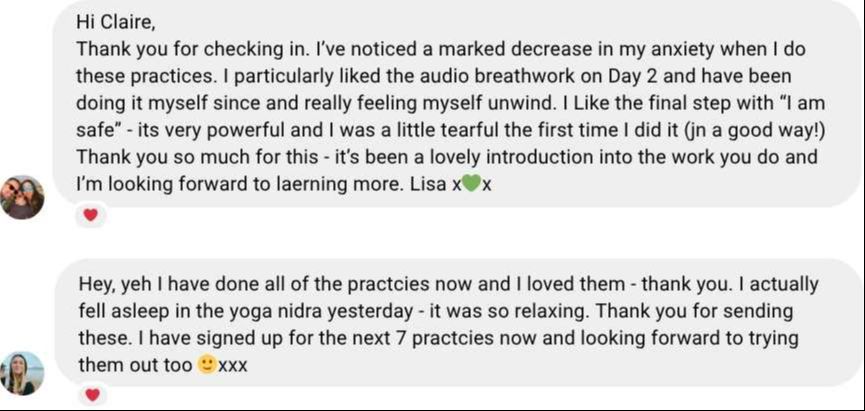
If you're newer to this way of working with your body, my free five-day journey is a gentle place to start building this kind of body awareness, at your own pace.
When grounding isn't enough on its own
Grounding techniques are genuinely helpful for everyday disconnection, but it's worth being honest that they aren't always enough on their own, and that's okay. If this kind of disconnection is frequent, severe, involves significant memory gaps, or feels connected to a complex trauma history, please be gentle with yourself and consider reaching out to a trained trauma therapist alongside any somatic work you do; some experiences deserve more support than a self-guided article or programme can offer, and there's real strength in asking for it.
If you'd like to understand more about the wider states your nervous system moves through, and how much activation you can safely hold before you tip into disconnection, my articles on the Window of Tolerance and your vagus nerve may be helpful companions to this one.
How Somatic Self Healing can help
Feeling disconnected from your body often develops because, at some point, your body genuinely needed a way to get through something overwhelming. It makes complete sense that it doesn't just switch off because you understand it intellectually; real change comes through repeated experiences of feeling safe enough to stay present, built slowly and gently, not through insight alone.
That's exactly what Somatic Self Healing is built to support. Through grounding, resourcing and gentle nervous system education, you'll learn to recognise when you've drifted, build genuine tools to come back, and slowly widen your capacity to feel present in your own life again.
You don't have to keep floating above your life, waiting to feel like you again. You're allowed to come home to your body, gently, at your own pace.

References
- Najavits, L. M. (2002) Seeking Safety: A Treatment Manual for PTSD and Substance Abuse. New York: Guilford Press.
- Nijenhuis, E. R. S. and van der Hart, O. (2011) 'Dissociation in trauma: A new definition and comparison with previous formulations', Journal of Trauma & Dissociation, 12(4), pp. 416-445.
- Ogden, P., Minton, K. and Pain, C. (2006) Trauma and the Body: A Sensorimotor Approach to Psychotherapy. New York: W. W. Norton.
- Porges, S. W. (2011) The Polyvagal Theory: Neurophysiological Foundations of Emotions, Attachment, Communication, and Self-Regulation. New York: W. W. Norton.
- van der Hart, O., Nijenhuis, E. R. S. and Steele, K. (2006) The Haunted Self: Structural Dissociation and the Treatment of Chronic Traumatization. New York: W. W. Norton.
- van der Kolk, B. A. (2014) The Body Keeps the Score: Brain, Mind and Body in the Healing of Trauma. New York: Viking.