Your vagus nerve: your in-built regulation hardware
Recently, everyone seems to be talking about the vagus nerve, and for good reason. By the end of this article, you may find yourself telling everyone you know about theirs too, because the vagus nerve really does sit at the heart of our wellbeing. The good news is this: we all have one.
The vagus nerve is not something you need to reset, hack or fix because it's broken. It is an already in-built system designed to support your regulation, safety, and connection throughout the body. We just need to learn how to harness it and work with it to support our wellbeing.
Table of contents
What is the vagus nerve?
The vagus nerve is the tenth cranial nerve, meaning it originates in the brain rather than the spinal cord. It is also the longest nerve in the body. The word vagus comes from the Latin vaga, meaning “wandering”, and it is named accurately. It travels from the brainstem down through much of the body, connecting brain and organs in constant communication.
It is actually a pair of nerves, which together form two main pathways: the ventral vagal complex and the dorsal vagal complex. We will explore these more deeply in later posts.
Where the vagus nerve travels
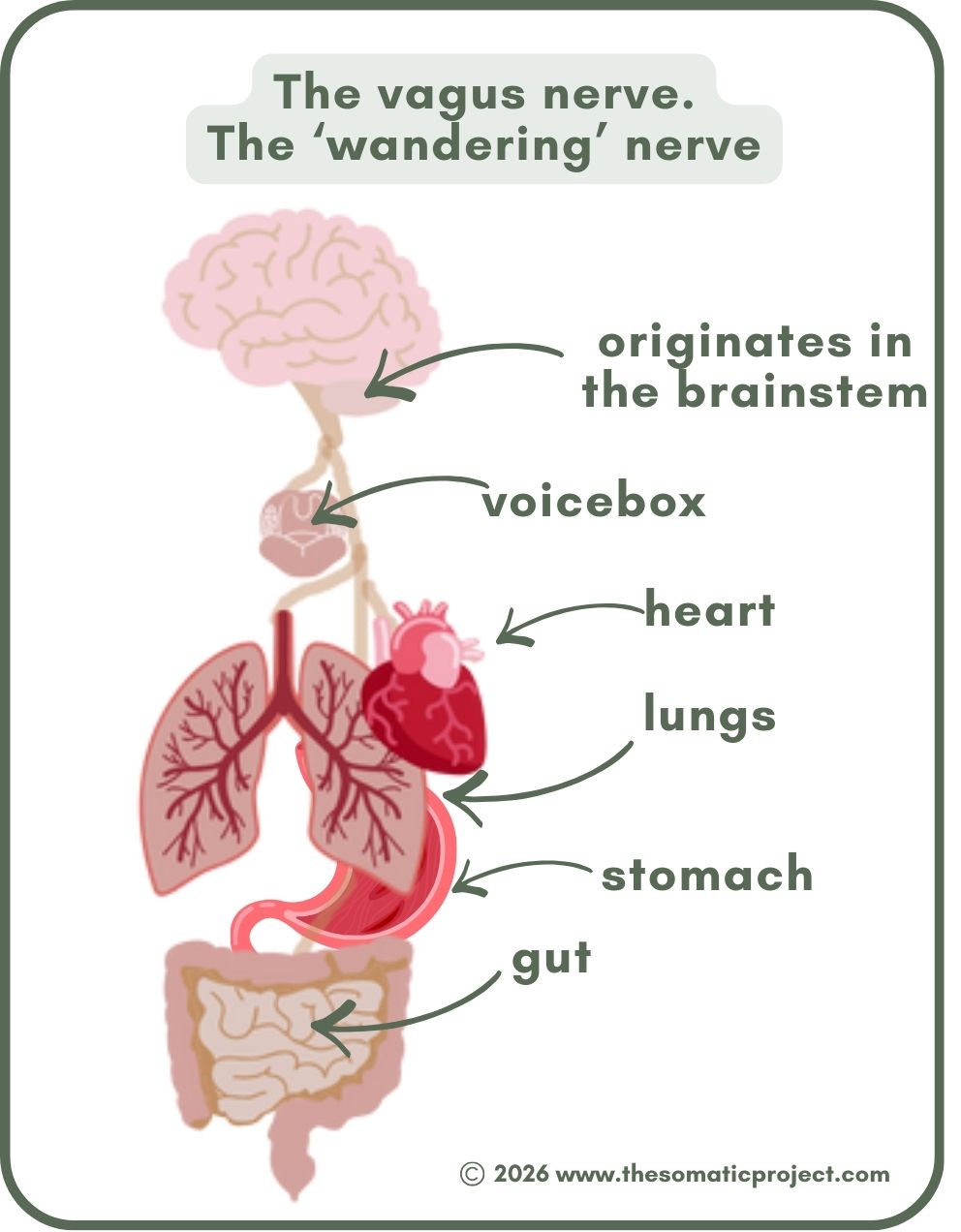
This pair of nerves emerges from the top of the brainstem at the base of the brain and then travels down through the body, connecting with the upper neck area behind the ears, the throat and vocal cords, the heart and lungs, the stomach and organs of digestion, and the intestines.
As it travels, the vagus nerve helps regulate swallowing, vocalisation, breathing, heart rate, blood pressure, digestion, immune responses, and the gut microbiome. There are very few systems in the body that are not influenced by this nerve.
The vagus nerve as a communication highway
The vagus nerve is the primary communication pathway of the parasympathetic nervous system, carrying signals of safety throughout the body. It also acts like a brake, reducing the amount of energy entering the body when it is safe enough to do so. So when the body registers safety, the vagus nerve activates and our survival energy is reduced; we feel more connected, calmer, balanced, and are able to think more clearly.
Crucially, around 80 to 90 percent of vagal neurons are afferent, meaning they carry information from the body up to the brain. Only about 10 to 20 percent carry signals from the brain down to the body.
This is why thinking your way out of stressful emotions or trying to tell yourself that you are safe often does not hit the mark on its own. A body-up approach is key to regulating the nervous system. We need to communicate safety to the vagus nerve in the language of the body; sensation, breath and movement.
Why the vagus nerve matters for healing
When the vagus nerve is activated, vagal pathways support regulation and the body can move out of survival and into repair. Heart rate steadies. Breathing becomes more efficient. Digestion and immune function improve. Now our resources aren't diverted towards survival, we are better able to access learning, connection, and emotional integration.
Research on vagus nerve stimulation suggests beneficial effects on brain activity, inflammation, mood, and stress responses, including potential clinical benefits for depression and PTSD symptoms.
Connection and the social nervous system
The vagus nerve is also deeply involved in connection. When safety is present, the vagus nerve's pathways support what is known as the social engagement system: the ability to make eye contact, listen, vocalise, and feel connected to ourselves and others. That's why when we are in the company of people we feel safe around, we feel more connected; our vagus nerve is active and our social engagement system is online.
Co-regulation is the subtle, often subconscious communication between two or more nervous systems. Each of us gives out signals of safety or threat through tone of voice, facial expression, and body language. Being around someone who feels grounded can help our own system settle, and dysregulation can also be contagious. That's why choosing who we spend our time with is very important; some people activate our vagus nerve, increasing its strength. These people are like gold dust.
Vagal tone and how to gently increase it
Vagal tone is the name for the strength of our vagus nerve, and therefore how effectively the vagus nerve supports regulation and recovery after stress. Higher vagal tone is often associated with greater flexibility in the nervous system, meaning it can move out of activation and return toward steadiness more easily. The more we strengthen our vagal tone, the more resilient we become, as our nervous system can quickly and efficiently bounce back after stress. Vagal toning is not about forcing ourselves to be calm. It is about practising cues of safety and regulation often enough that your system becomes more responsive over time.
There are many ways we can increase our vagal tone. Here are some you can have a go at:
- Gentle, mindful movement (yoga, tai chi, qigong, pilates). To support vagal tone, practise with mindfulness by noticing sensations of movement as they happen. If you notice yourself becoming distracted, gently return to the body. You can explore this with my Somatic Yoga for Stress Relief series. Click here for a free 7 day trial.
- Breathwork practices. One of the most effective ways to improve vagal tone is diaphragmatic or belly breathing. This relaxes the diaphragm muscle (our primary breathing muscle), which signals safety to the vagus nerve. You can learn many more vagal toning breathwork techniques in Module 3 of Somatic Self Healing.
- Co-regulation through safe connection. Spend time with calming people or animals, listen to soothing voices, relaxing music, and watch feel-good films.
- Cold as a gentle stress cycle. Cool water can activate the survival system, and slow breathing can help guide it back down by activating the vagus nerve. Please keep it safe: there is no need for icy water or cold swimming alone. Splashing your face and wrists or turning the shower cooler is enough.
- Harness your voice. Humming, singing, or making a long “voooo” sound creates vibration in the voicebox that can activate the vagus nerve. The yogis have explored chanting for thousands of years through mantra. To combine voice with co-regulation, consider joining a choir or chanting group. There is more on sound practices in Module 2 of Somatic Self Healing.
- Support your gut microbiome. A healthy and diverse microbiome signals safety to the vagus nerve, which culminates in the gut. To support microbiome diversity, go for variety: more fruits and vegetables, fermented foods (sauerkraut, kimchi, live yoghurt, kombucha), and reducing ultra-processed foods and excess alcohol.
A closing note
Remember, (despite the rhetoric on social media these days!) your vagus nerve is not something you need to hack. It is already doing its best to support you. Somatic practice simply helps us to work with our vagus nerve, communicating with our body in the language it understands, so it can do it's job with more ease.
References
- Porges, S. W. (2022). Polyvagal theory: A science of safety. Frontiers in Integrative Neuroscience, 16.
- Dana, D. (2018). The polyvagal theory in therapy: Engaging the rhythm of regulation. W. W. Norton & Company.
- Groves, D. A., & Brown, V. J. (2005). Vagal nerve stimulation: A review of its applications and potential mechanisms. Neuroscience & Biobehavioral Reviews, 29(3), 493–500.