How to Widen Your Window of Tolerance (and Why It Matters for Trauma Healing)
Understanding your Window of Tolerance can be a very helpful tool for bringing self awareness to your nervous system’s capacity - a key skill when it comes to healing, and generally for life!
You might have heard the phrase “feel it to heal it.” And there is truth in that. At some point in our healing journey, we do need to feel the difficult emotions that have been held in the body. This is how they are processed and integrated.
In the past, it was often believed that catharsis was the answer. That we needed to release everything, feel the full intensity of our pain, and let it all out at once. But more up to date, truly trauma aware approaches understand something important: you do not have to feel the full intensity of everything all at once. In fact, doing so can be overwhelming or even re-traumatising.
Healing is safer and more effective when it happens slowly, gently, and within the capacity of your nervous system.
This is where understanding your Window of Tolerance becomes so powerful. It helps you recognise how much your system can process at any given time, and how to work at the edge of your capacity without tipping into overwhelm or shutdown.

In this article, we will explore what the Window of Tolerance is, why trauma and chronic stress can narrow it, and how it can gently be widened over time so your nervous system becomes more resilient.
Table of contents
What is the Window of Tolerance?
The Window of Tolerance is a term developed by Dr Dan Siegel (2012). It describes the optimal zone of arousal where we can effectively manage stress, stay present, think clearly, and respond flexibly to what life brings.
When we are within our window, we might still feel stress, sadness, frustration or fear. But we are able to stay connected to ourselves. We can reflect, choose how to respond, and recover more easily.
Our nervous system naturally fluctuates throughout the day as we move up and down in energy, and this is healthy and natural. The difficulty arises when we move outside of our window, so getting to know what it feels like inside and outside of your window is really important.

What happens when we go outside our window?
When we are pushed beyond what our system can tolerate, this is when we enter survival states like fight, flight, freeze or shutdown.
We can think of our window of tolerance as our optimal energy arousal. So, if we move above our window, we enter hyperarousalA high-energy survival state where the nervous system is activated. Often felt as anxiety, panic, urgency, agitation, or overthinking. (or too high energy). This is where fight and flight live and where we are likely to feel anxiety, panic, irritability, restlessness, overthinking and urgency.
If we drop down below our window, we enter hypoarousalA low-energy survival state where the nervous system conserves energy. Often felt as numbness, heaviness, fatigue, shutdown, or disconnection. (or too low energy). This is where shutdown lives so we might feel numbness, heaviness, fatigue, disconnection or hopelessness.
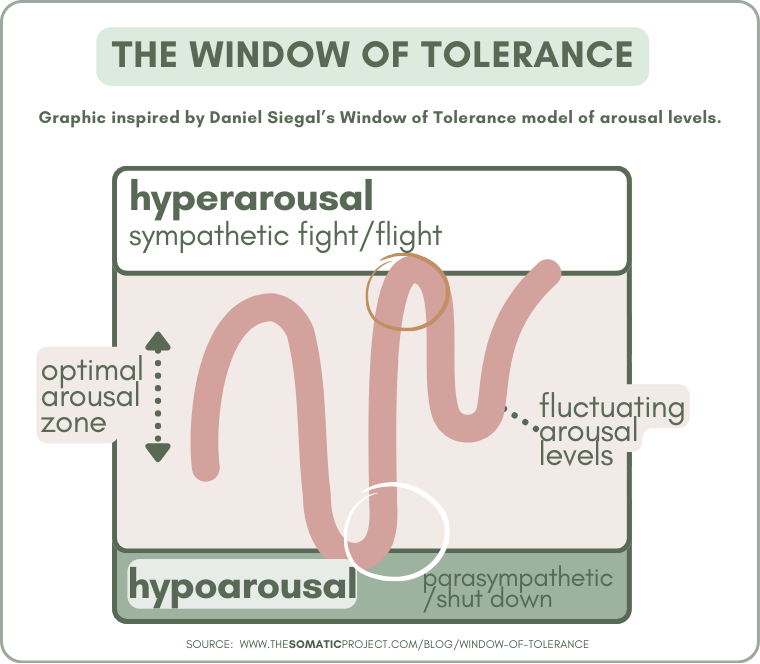
Moving outside of our window either upwards or downwards doesn't mean that there is something wrong with you, it means your nervous system is utilising survival states to help you to cope and feel more like you can survive. But when we spend too much time outside our window and in these survival states, daily life becomes harder as we might feel constantly on edge, or disconnected, small stressors can feel enormous and we can become less resilient to stress.
You might reflect on your own week: Were there moments you felt steady and present? Were there moments you felt pushed into overwhelm or collapse? This can give you an idea of when you have been within and outside your own window of tolerance.
How trauma and chronic stress narrow the window
Chronic stress and trauma can narrow our Window of Tolerance over time, through a number of ways:
- NeuroceptionYour nervous system’s automatic detection of safety or threat, happening beneath conscious awareness. becomes disrupted. Our nervous system becomes more likely to detect danger, even when there is none.
- Vagal toneA term used to describe how effectively the vagus nerve supports regulation and recovery after stress. Higher vagal tone is often linked with greater nervous system flexibility. lowers. The vagus nerve becomes less effective at bringing us back into regulation.
- Brain structures are impacted. The prefrontal cortex, which helps us think clearly and regulate emotion, becomes less accessible under stress, while the amygdala becomes more reactive (van der Kolk, 2014).
- Stress hormones increase. Ongoing cortisol and adrenaline keep the body on high alert (Sapolsky, 2004).
- Protective patterns form. Breathing can become more rapid or shallow, muscles might brace and movement patterns can become tight or restricted.
The result is that situations we once could cope with now push us outside our window more quickly.
For example, if you are already under financial pressure or caring for someone unwell, a small inconvenience might suddenly feel like the final straw. It is not that you are weaker but that your window is simply narrower at that time.
The good news: the window can widen
One of the wonderful things about the nervous system is that it is flexible, adaptive and capable of change. This is called neuroplasticityThe brain and nervous system’s ability to change and rewire through experience, repetition, and learning.
As healing happens, the Window of Tolerance can widen again. This means:
- Neuroception regains balance so stressors that previously pushed you outside of your window no longer do.
- Vagal tone increases, making your body more able to physically bounce back from stress.
- The prefrontal cortex becomes more effective, helping you think clearly and rational in situations where you might not have been able to access logical thinking previously.
- Communication across the brain improves, helping you to process and integrate emotional events.
- Stress hormone levels reduce, impacting your physiology - improving your energy levels, immune function, blood pressure etc.
- The body begins to let go of chronic tension and protective patterns which can lead to a reduction in chronic pain and inflammation.
With a wider window, we can stay within an optimal zone of arousal even in situations that would previously have activated a survival response - we become more resilient to stress.
The sweet spot of healing
Just at the edge of our Window of Tolerance is a zone where we can experience distressing emotions and sensations without becoming overwhelmed or dissociated. This is the sweet spot of healing.
By getting into this zone we are feeling it in order to heal it. But we are doing so in a way that keeps us feeling safe, present and connected.
Practicing staying near this edge supports neuroplasticity as we are teaching the nervous system that it can tolerate more than it previously believed. Over time, this widens our window.
One of the key techniques that supports this is pendulationGently moving back and forth between a mildly uncomfortable sensation and a resourcing sensation, so the nervous system can process activation without becoming flooded., a term used in Somatic ExperiencingA body-based approach to healing trauma developed by Peter Levine, focused on completing stress responses and restoring nervous system regulation. (Levine, 2010). Pendulation means gently moving back and forth between a slightly uncomfortable sensation and a resourcing or regulating sensation. This back and forth movement allows us to process activation in small doses without flooding or overwhelming us.
How to gently widen your Window of Tolerance
Widening the window is not about pushing yourself to tolerate more distress. In fact, forcing yourself into overwhelming experiences can narrow it further...so let's not do that!
This is why the three step process inside Somatic Self Healing begins with safety, resourcing and regulation before any deeper processing work.
First, we build a felt sense of safety in the body. This might include supportive self holds, grounding practices, breathwork and resourcing. This means identifying sensations, memories, people or practices that bring even a small sense of steadiness. We practice returning to these resources again and again so the nervous system learns it has somewhere to come back to. Without safety, processing can easily become re-traumatising.
Second, we process difficult sensations and emotions safely. Using the skills already learnt in the first step (resourcing and regulation) we are able to move closer towards difficult sensations into that zone on the edge of our window. Using titration and pendulation techniques we gently feel what is there in a safe way. Only once the foundations are in place do we begin working closer to the edge of the window. Because now the system knows how to come back.
Third, we integrate these experiences using parts-work, self-compassion and inner child healing; creating a new, coherent and helpful narrative around the memories, sensations and emotions. This helps to place those experiences within our window so we are no longer overwhelmed or pushed into shut down when we are reminded of them.
This is why working within a structured container like Somatic Self Healing, or with a trained somatic practitioner, can be so supportive.
Healing is not about pushing yourself to tolerate everything; it is about gradually increasing capacity in a way your body can trust.

A closing note
I hope this introduction to your Window of Tolerance has helped you see what a compassionate and practical guide this model can be. It gives us a way to understand our capacity without judgement, and a way to approach healing that is safe rather than forceful.
If your window feels narrow right now, I hope this has also given you some reassurance. A narrow window is not a flaw in you; it is a nervous system that has adapted to what it has lived through. And the beautiful thing about the nervous system is that it is flexible and it can change - this is what happens on the healing journey.
Through slow, safe, body-based work, we can widen that window again. We can rebuild resilience. We can learn to stay present with more of our experience without tipping into overwhelm or shutdown.
This work is not dramatic or about pushing yourself too fast or too hard - it is steady, often slow and always gentle. And over time, that gentleness creates real change leading to more capacity, more choice and more peace.
References
- Siegel, D. J. (2012). The developing mind. Guilford Press.
- Porges, S. W. (2011). The polyvagal theory. W. W. Norton & Company.
- Porges, S. W. (2017). Polyvagal theory: A science of safety.
- Levine, P. A. (2010). In an unspoken voice. North Atlantic Books.
- van der Kolk, B. (2014). The body keeps the score. Viking.
- Sapolsky, R. M. (2004). Why zebras don’t get ulcers. Holt Paperbacks.