How to get out of freeze and shutdown: two different nervous system states
You might have heard of the 'freeze response' or 'shut down' state? Freeze and shutdown are often used interchangeably, and from the outside, they can look very similar. But inside the body, they are actually two distinct nervous system responses, and understanding the difference matters as it helps us to know what our own body needs for support when we feel stuck.
Both freeze and shutdown are intelligent survival responses (more on this later), they are not signs of weakness, laziness, or failure. They are ways the nervous system has learned to protect you when something feels overwhelming or unsafe.
In this article, we will explore what freeze and shutdown are, how they differ, what they can feel like in the body, why they happen, and gentle ways to support your system back toward safety.
Table of contents
Freeze and shutdown are not the same
Freeze and shutdown can both involve stillness, difficulty taking action, or a sense of being stuck. This is why they are often confused. But internally, they are very different states, and the body needs different kinds of support in each one.
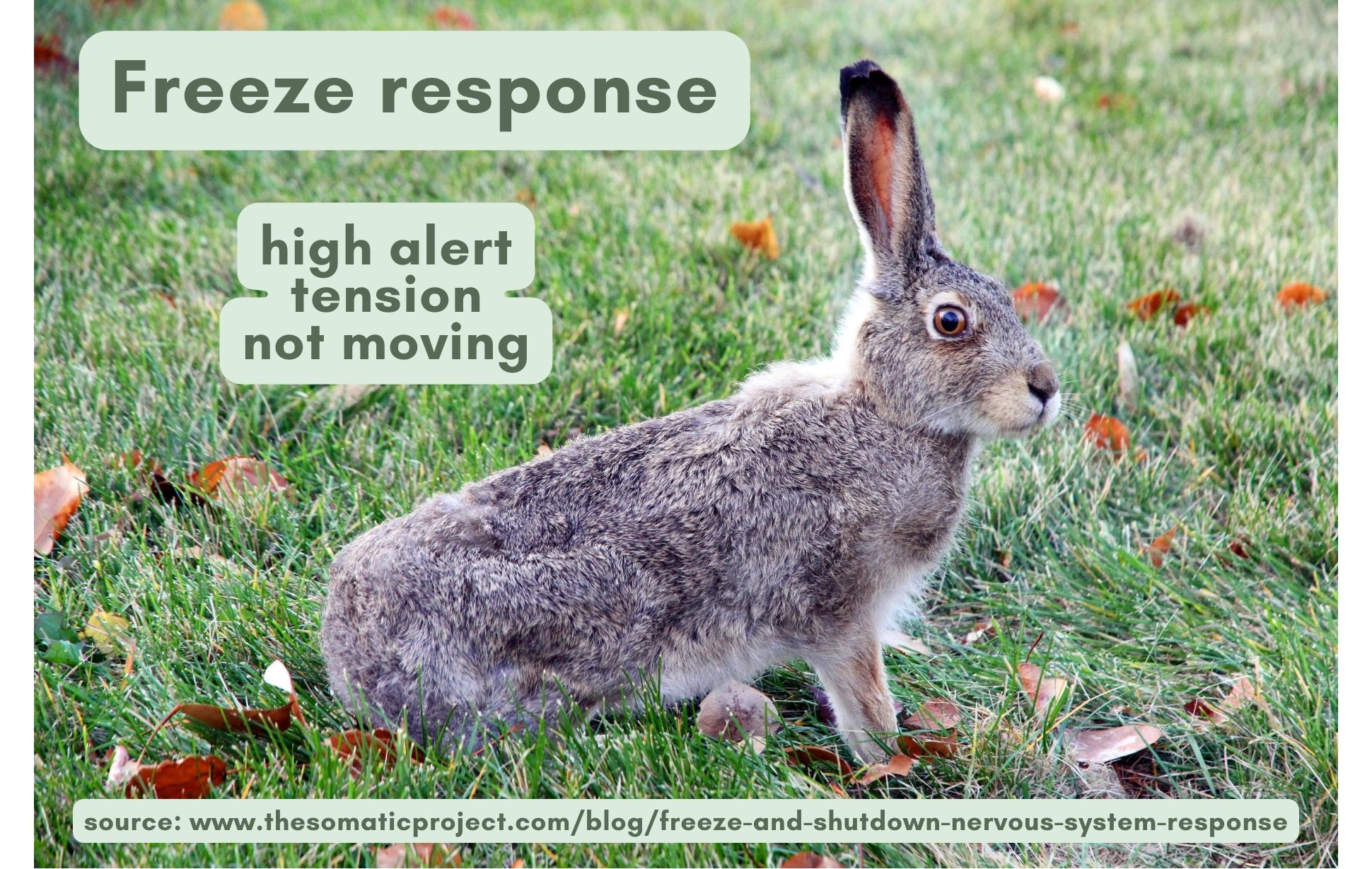
Freeze is a state where the body is highly alert but unable to move (think rabbit in the headlights). Shutdown is a state where the body conserves energy by pulling inward and reducing activity (like an animal feigning death). One is a state of tension and holding, the other of collapse and withdrawal.
Understanding which state you are in can help explain why certain practices feel supportive while others feel too much or not enough.
Understanding the freeze response
The freeze response happens when the nervous system is both activated and inhibited at the same time. In polyvagal theory* terms, this means sympathetic mobilisation (high energy, high alert) combined with dorsal vagal shutdown (low energy, immobility).
*Polyvagal theory is a model of the nervous system, created by Steven Porges, which helps us understand our physiology and behaviour when our body perceives threats vs safety.
It can feel like having one foot on the accelerator and one foot on the brake; the body is ready to act, but unable to.
People often describe freeze as feeling stuck, paralysed, overwhelmed, or unable to decide what to do next. From the outside it can look like procrastination or indecision, but inside there is often a lot of tension and fear.
In a freeze state, you might notice:
- a sense of being frozen or trapped
- muscle tension throughout the body, especially in the hips, shoulders, neck, diaphragm, or pelvic floor
- wide or hypervigilant eyes
- shallow breathing
- thoughts like “I don’t know what to do”, “this is too much”, or “I can’t move”
Freeze can be a frustrating place to find yourself as it's not a lack of motivation, it's the inability to act or move forwards. It is the nervous system trying to protect you by stopping movement when danger feels overwhelming.
Understanding shutdown
Shutdown is a dorsal vagal parasympathetic state (a very low energy state initiated by activation of the lower part of the vagus nerve). It is the nervous system’s response when escape or defence feels impossible and the body conserves energy and feeling by pulling inward and going numb.
This is sometimes described as the body “playing dead”. It is ancient, adaptive, and protective and we can see this in nature when animals fien death in extreme danger.
In a shutdown state, the energy is heavy and downward, the body may feel collapsed, numb, or disconnected. Rather than feeling tense and alert like in a freeze state, there is often a sense of withdrawal, disconnection from the environment and low muscle tone (the body goes floppy).
In shutdown, you might notice:
- heaviness or emptiness in the body
- slumped posture or reduced muscle tone
- very shallow or barely noticeable breath
- slowed digestion and low energy
- emotions such as hopelessness, apathy, or deep fatigue
- thoughts like “what’s the point” or “I can’t do this anymore”
Over time, this state can be experienced as numbness, disconnection, depression or ongoing exhaustion. Again, this is not that your body is doing something wrong, it is the nervous system utilising an ancient and highly compassionate system to help you feel as safe as possible in times of perceived threat.

Why the nervous system goes into freeze or shutdown
The nervous system has a survival hierarchy - we explore this in detail in Somatic Self Healing to help you map your own nervous system imprints and survival responses. When danger is perceived, it will first attempt to protect us by mobilising fight or flight. If that does not feel possible or safe, the system will move into freeze, or shutdown.
In modern life, many threats are psychological rather than physical, and as opposed to the short, sharp events (think the lion chasing the gazelle!) of nature, our human threats are often repeated, chronic, and can last weeks, months or even years. Emotional neglect, bullying, chronic stress, financial pressure, or repeated experiences of feeling powerless can all activate survival responses, even when there is no physical danger. Over time, our nervous systems might attempt to use fight or flight at first, but if these strategies don't work on modern day threats, our nervous system may move down the hierarchy to use freeze or shut down.

If you would like to understand the earlier stages of this survival sequence, you might also find it helpful to read Understanding fight and flight.
Why coming out of shutdown can feel unsettling
When the nervous system begins to move out of shutdown, it does not usually go straight into feeling safe and calm.
Often, it passes back through sympathetic activation. This can look like increased heart rate, anxiety, agitation, restlessness, or even anger. While this can feel alarming, it is often a sign that the system is waking up and mobilising again.
Deb Dana’s polyvagal ladder is a helpful way of understanding this process. Moving upward toward safety often involves passing through earlier survival states on the way.
This is one reason why going slowly and having support matters. Without understanding what is happening, people can feel like they are getting worse, when in fact the nervous system is beginning to move.
Supporting freeze and shutdown gently
Freeze and shutdown benefit from different kinds of support, and in both cases, less is often more.
When working with freeze, the body needs to learn that it is safe to move again. This can include:
- very small, slow movements
- rocking or swaying
- gentle circular movements of the shoulders, wrists, ankles, or spine
- bilateral movements or eye movements
The emphasis is on choice, curiosity, and staying within your window of tolerance.
When working with shutdown, the nervous system benefits from warmth, containment, and a gradual return of energy. This might include:
- shapes that support the body, such as child’s pose or foetal position
- gentle rocking or self-soothing touch
- slowly pulsing the feet into the ground to invite tone back into the body
- moving gently between contracted and slightly more open postures
If you would like a foundation in regulation skills that support these processes, you might also find this article helpful: Nervous system regulation, as well as Your vagus nerve: your in-built regulation hardware.
Why support and containment matter
Freeze and shutdown are responses that developed in overwhelm. For many people, working with these states is not something that needs to be done alone.
Having the support of a trained somatic practitioner, or working within a structured container like Somatic Self Healing, can help ensure that this work happens slowly, safely, and with enough regulation and resourcing.
Healing is not about forcing the body to change. It is about creating the conditions where the nervous system feels safe enough to move again.
A closing note
I'm a firm believer in de-pathologising these protective responses. Freeze and shutdown are not problems to be fixed. They are signs of a nervous system that adapted intelligently to survive. Depression, dissociation, withdrawal, procrastination can all be understood compassionately through the lens of the nervous system states. & with this compassionate understanding comes the opportunity to begin to work with your nervous system with kindness, rather than against it. Somatic healing invites a different relationship with these states. One that listens rather than pushes, that supports rather than overrides, and that trusts the body’s timing.
With enough safety, support, and patience, the nervous system can learn that it no longer needs to stay frozen or shut down. And when that happens, movement, connection, and vitality can begin to return naturally.
References
- Porges, S. W. (2011). The polyvagal theory. W. W. Norton & Company.
- Porges, S. W. (2017). Polyvagal theory: A science of safety.
- Levine, P. A. (2010). In an unspoken voice. North Atlantic Books.
- Dana, D. (2018). The polyvagal theory in therapy. W. W. Norton & Company.