How Can You Release Trauma From the Body?
The idea of “releasing trauma from the body” has become increasingly common in therapeutic and wellness spaces. It suggests that trauma is something physically stored within us, waiting to be expelled or discharged. For many people, this language feels hopeful - as though there might be a clear, tangible way to finally feel free....
On your search for healing support, you might have come across phrases like "release your trauma", "trauma is stuck in your body" or "trauma release"...?
But trauma is far more nuanced than something we can simply push out. To understand how healing truly works, we first need to understand what trauma actually is; physiologically, neurologically, and relationally.
In this article, we’ll explore what trauma actually is, how it becomes held in the body, what people mean by “releasing trauma,” and how healing can happen in a way that is safe, gradual and deeply respectful of your nervous system.
Table of contents
- What is trauma, Really?
- How trauma is stored in the body and brain
- Releasing the Myth of “Release”
- What can we learn from nature about trauma?
- How our bodies carry the imprint of the past
- So… Can you release trauma from the body?
- How to safely encourage the nervous system to complete the survival responses.
- How to heal trauma safely.
- Conclusion: From Release to Integration
- References
What is trauma, Really?
Trauma is a deeply subjective experience and is not defined by what happened in an event. Trauma refers not to what happened, but to what happened inside the nervous systemThe integrated network of brain, spinal cord and peripheral nerves that regulates stress responses, emotion, movement and survival physiology. when an experience overwhelmed our capacity to cope. And because we all live in unique bodies, with unique pasts, different capacities, vulnerabilities, and different support systems; two people can live through the same experience and emerge with very different nervous system responses.

At its core, trauma involves a loss of agency &/or feelings of helplessness. It is the experience of our body mobilising energy for survival (to fight, flee, cry out or defend ) and finding that none of those actions are possible or safe. So, this might occur if you have been physically trapped, or maybe you were a child when the event(s) occurred and you were dependent on your caregivers so couldn't run or fight. Maybe it wasn’t socially safe to react due to societal norms and rules. As Peter Levine (founder of Somatic Experiencing) explains, trauma occurs when the natural survival response is thwarted as the body prepares for protective action, but that action cannot complete.
The energy does not simply disappear. Instead, the nervous system reorganises around that unfinished response and we can be left feeling on high alert (e.g. anxiety) or shut down (e.g. depression).
This is what Bessel van der Kolk famously writes about in his ground-breaking book: “The body keeps the score” (van der Kolk, 2014) where he explains:
“The imprint of trauma does not sit in the verbal, understanding, part of the brain, but in much deeper regions - amygdala, hippocampus, hypothalamus, brain stem - which are only marginally affected by thinking and cognition.”
These parts of the brain that are effected by trauma are subconscious feeling parts, involved in our survival responses, emotions and memory. This is is why trauma is so often felt rather than remembered in words or images. It can live in posture, breath, tension, startle responses, shutdown states and relationship patterns.

How trauma is stored in the body and brain
When a part of the brain called the amygdalaA brain structure responsible for detecting threat and initiating survival responses. perceives danger, it triggers a cascade of stress hormones such as cortisol and adrenaline. These chemicals prepare the body for survival with the fight or flight response. Under manageable conditions, another part if the brain called the hippocampusA brain structure that helps organise experiences into coherent, time-bound memories. helps us to put this event within the context of our wider life, filing it away as something that happened in the past.
However, when an experience is overwhelming, the stress response can flood our brains with the stress hormone cortisol. When there is too much cortisol, the hippocampus struggles to time-stamp the event accurately and instead of being integrated into a clear memory we can recall from the past, the experience may be stored in the amygdala as feelings, emotional states, and physiological reactions like shallow breathing and tensing muscles.
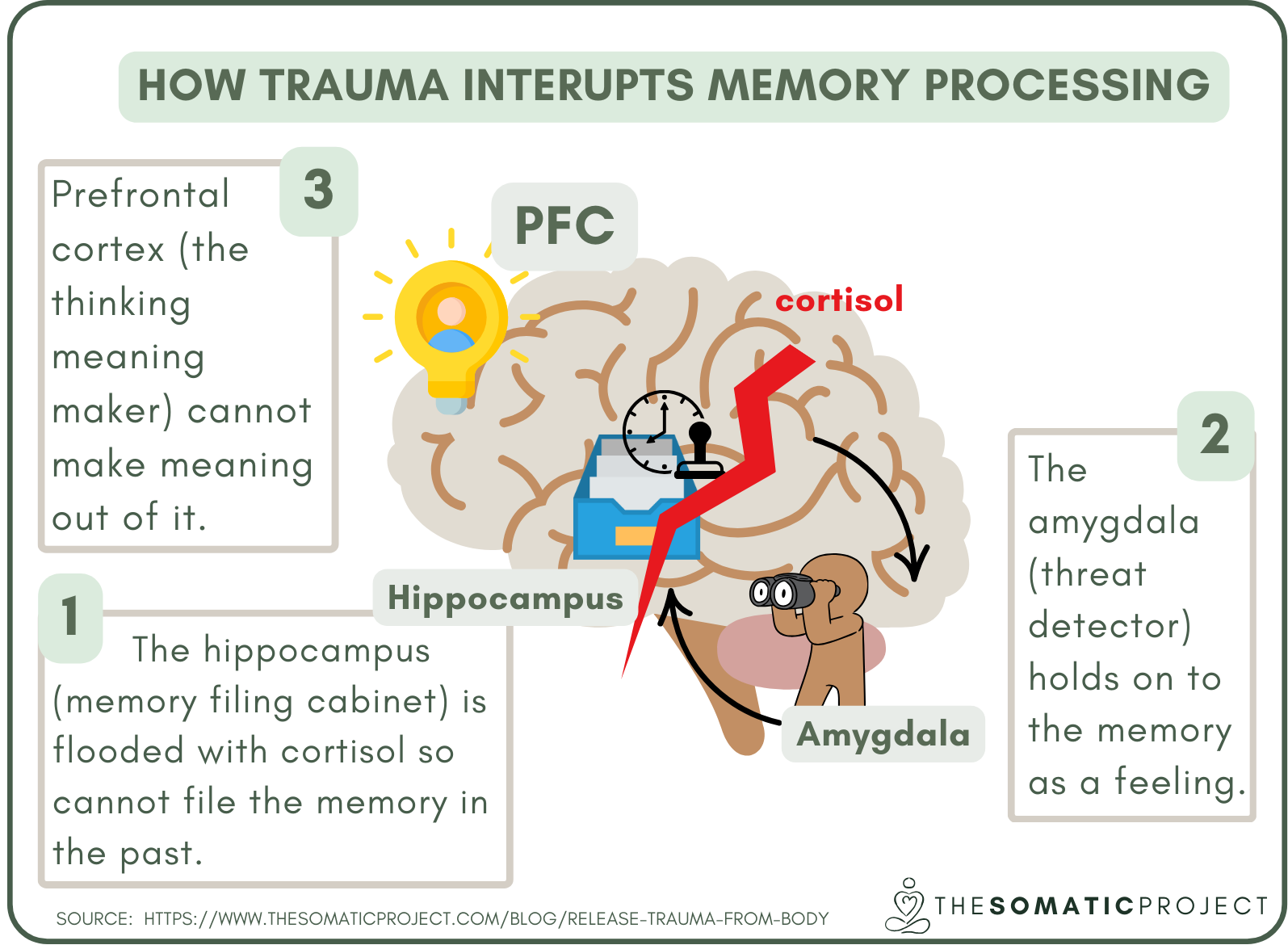
This is what is often referred to as an implicit memory or "feeling memory"An emotional and physiological imprint stored in the body and lower brain, often without words or a clear sense of time.. These memories do not feel like clear recollections of the past, instead they feel like present reality.
Later, when something in the environment reminds us of the original experience; it might be a tone of voice, a smell, a facial expression, an internal sensation, the amygdala may reactivate that feeling memory as if the threat is happening again now. The body responds quickly to try to keep us safe in case the event(s) is happening again.
This is why trauma can show up as sudden feelings of anxiety, shame, numbness or rage. Sometimes we might be aware of what has activated us (or "triggered" us - but I don't like that term so much) or sometimes it might be under our conscious awareness e.g. something we sensed in our body like a smell or movement but didn't think about in our mind.
Dr Janina Fisher describes it beautifully:
“Many survivors say ‘I don’t remember anything’ without realising they are remembering when they suddenly startle, feel afraid, tighten up, pull back, feel shame or self-hatred or start to tremble.” (Fisher, 2021)
Releasing the Myth of “Release”
In many healing spaces and circles (I've especially noticed this as a trend on social media), trauma is described as something that is stuck in our bodies.... implying dysfunction or failure. But what if the body is not malfunctioning? What if it is protecting in exactly the way it is designed to do. Understanding this is really the first cornerstone of trauma healing, as it allows us to unlock compassionate understanding for why we are how we are.
The reactions and behaviours we often notice with trauma include hypervigilance (like anxiety, panic), dissociation (feeling disconnected from our bodies), shutdown (numbness, fatigue or depression) or submitting (prioritising other's needs over our own) are all learnt or adaptive patterns. They were intelligent strategies we adapted towards because they reduced our sense of danger, or they helped us feel safe by preserving attachment/relationships to others... They helped us survive.
From this perspective, trauma is not something toxic lodged inside us that must be forcibly expelled. It is a protective pattern that made sense at the time.
For a long time, healing was associated with catharsisAn intense emotional release often encouraged as a way to purge distressing feelings. - dramatic crying, screaming or reliving trauma in full intensity.
While expression can sometimes be helpful, and we'll dive into this a little later in the article) forcing someone to relive overwhelming experiences without enough safety can push the nervous system straight back into survival states.
This can narrow your Window of ToleranceThe optimal zone of arousal where you can feel emotions and stay present without becoming overwhelmed or shut down. rather than widen it.
If you are not familiar with that model, you might like to read more in my article on widening your Window of Tolerance.
Trauma-aware healing recognises that you do not need to feel everything at once in order to heal. In fact, that can overwhelm the system. Healing happens when we feel manageable amounts, safely.
To do this, Somatic healing shifts the question from “How do I get rid of this?” to “How do I understand what my body has been trying to do for me?” and then instead of trying to get rid of the feelings, we support our bodies in feeling safe again and change our relationship towards those feelings to help listen to, support and process them.

What can we learn from nature about trauma?
Nature is a wonderful teacher - and has a lot to teach us about trauma. Interestingly, truly wild animals don't get traumatised in the same was as humans do....that is unless they are captured and domesticated by humans. Let's look at why that is:
In the wild, animals' nervous systems mobilise for fight or flight (just like ours do) but the difference is they complete the stress cycle instinctively. They run! They fight! They roar! & then after the threat (if they haven't been caught or killed by a predator or competitor, they move any excess energy in their bodies through by shaking, trembling, running or vocalising. This metabolises stress hormones and releases muscle tensions and their physiology returns to baseline so they are not carrying that excess energy with them.

Human stress is often different. It might be that our stressors are psychological rather than physical; for example bullying, emotional neglect, discrimination, financial pressure. Or it might be a case of power imbalance where a dominant (e.g. adult) human harms a human who cannot physically run away or fight off (e.g. a child), or it would not be safe for them to do so.
In any of these examples, the human body still mobilises for survival, but social norms or entrapment may prevent physical completion of those responses: We stay seated. We suppress tears. We are not strong enough to fight back. We override the impulse to shout or leave.
Over time, repeated interruptions to the stress cycle can lead to chronic dysregulation, narrowing our Window of ToleranceThe optimal zone of arousal where a person can experience emotion while remaining present and regulated. and this can leave us more prone to entering survival states as our nervous system is on edge and expecting more of the same.
How our bodies carry the imprint of the past
Trauma is not only about recent events. Our earliest experiences are fundamental in shaping our nervous system - especially those experienced involving fear, unpredictability or attachment rupture. Even experiences that were so early on in our life that we cannot cognitively remember them, shape how the nervous system expects the world to be.
As our nervous system learns about the world and adapts to try to keep us feeling as safe as possible in the circumstances, these experiences can disrupt our neuroceptionThe nervous system’s automatic scanning for cues of safety or threat beneath conscious awareness., making us more likely to interpret neutral situations as unsafe. They can alter breathing patterns, muscle tone, posture and facial expression.
This is why two people may respond very differently to the same situation; each of our nervous systems carry a different history.

So… Can you release trauma from the body?
Yes; but not in the way social media sometimes suggests.
Trauma release is not about purging something toxic from inside you.
It is about allowing incomplete survival responses to gently complete.
It is about helping the body move from frozen or hyper-alert states back into regulation.
It is about integration, and completion...not expulsion.
How to safely encourage the nervous system to complete the survival responses.
When we turn towards and befriend our bodies with kindness and curiosity, we can learn exactly what it is they need to do to shift from the past to the present. Our bodies carry this wisdom - we just need to learn to listen! & when we listen to our bodies we can learn what we need to support the nervous system in doing what it was always designed to do: complete the interrupted survival responses safely.
This is not a sudden, one off purge or release (like you might have seen in videos online) but a gradual and repeated process which builds trust and remains gently and most importantly, safe.
This process is what we follow within Somatic Self Healing; it is gradual and structured, typically involving:
- Discernment: Recognising whether a reaction is a trauma response rather than a present-day threat.
- Somatic awareness: Locating activation in the body.
- Somatic listening: Understanding what those sensations are communicating.
- Expression: Allowing small, titrated (little by little) movements, breath changes or vocalisations.
- PendulationMoving gently between activation and regulation to prevent overwhelm while processing distress.: Moving in and out of activation while staying regulated.
- Regulation: Using breathwork, resourcing and grounding to maintain safety and stability, always working within our Window of Tolerance.
Remember, this is not about forcing emotion or inducing catharsis. Overwhelming the system can reinforce trauma rather than resolving it.
Healing occurs when the nervous system learns that activation can arise and settle without catastrophe.
How to heal trauma safely.
Safe and effective trauma healing unfolds in three phases... Somatic Self Healing is designed around these stages, which are grounded in the work of trauma healing experts Judith Herman (1992) and Janina Fisher (2017), whose three-phase models outline a safe and effective framework for trauma treatment*: safety and stabilisation, processing, and integration:
1) Creating Safety and Resourcing (Foundations)
Before processing traumatic experiences, we establish regulation. This may include strengthening vagal toneA measure of how effectively the vagus nerve supports calm, connection and recovery after stress., building grounding practices and developing internal resources.
2) Processing in Titrated Doses
Only once regulation and resourcing are stablished as skills do we approach traumatic activation in small, manageable increments. By listening to the body with curiosity we can learn what our body needs to process the activation; this might come from movement, breathing or vocalisation. By approaching difficult sensations in small doses, with the safety net of regulation already in place, we are supporting healing and integration rather than re-traumatisation.
3) Integration
Integration involves welcoming a kinder and more compassionate relationship towards the parts of us that had to adapt to keep us safe. Once safety and compassion are established we are more resourced to look at memories from a kind and objective point of view, allowing the experience to move from implicit bodily memory (feeling memories) into explicit narrative memory (thought memories).
It might be interesting to note that the physical “release,” when it occurs in phase two, is only a small part of this larger process.
If trauma lives anywhere, it lives in the intelligent adaptations your body made to survive.
Your anxiety. Your shutdown. Your hypervigilance. Your numbness. These were solutions once.
Somatic healing is about recognising where a cage still exists around your natural instincts… and gently, safely allowing that trapped survival energy to move. Not by force. Not by catharsis. But through a kinder, more curious relationship.
* Somatic techniques can be supportive, but people with a complex trauma history, with severe PTSD or dissociation may need additional guidance from a trained trauma therapist.
Conclusion: From Release to Integration
If you came here hoping for a technique to “get it all out,” I hope what you’re leaving with instead is something kinder.
Your body is not holding trauma because it is broken....It is holding it because at one time, that was the safest option available.
Healing is not about forcing release. It is about creating enough safety that your nervous system no longer needs to hold on in the same way.
And that kind of healing does not happen in a single dramatic moment; it happens slowly, gently and repeatedly.
Through curiosity, compassion and safety, over time our bodies can learn that they are no longer trapped.
References
- Fisher, J. (2021) Healing the Fragmented Selves of Trauma Survivors: Overcoming Internal Self-Alienation. 2nd edn. New York: Routledge.
- Herman, J.L. (1992) Trauma and Recovery: The Aftermath of Violence—From Domestic Abuse to Political Terror. New York: Basic Books.
- Levine, P.A. (1997) Waking the Tiger: Healing Trauma. Berkeley, CA: North Atlantic Books.
- Porges, S.W. (2011) The Polyvagal Theory: Neurophysiological Foundations of Emotions, Attachment, Communication, and Self-Regulation. New York: W.W. Norton & Company.
- van der Kolk, B.A. (2014) The Body Keeps the Score: Brain, Mind, and Body in the Healing of Trauma. New York: Viking.