Nervous System Regulation: What it is, Why it matters, and How it supports trauma-informed healing
Contents
In recent years, nervous system regulation has become a widely used phrase in wellness, psychology and trauma recovery. Yet for many people, it remains unclear what regulation actually means, why it matters, or how it relates to healing.
At The Somatic Project, we work from the understanding that your nervous system shapes the way you feel, connect, think and relate. Regulation is not about forcing calm or avoiding stress, but about helping the body return to a felt sense of safety more easily and more often. When your body feels safe, your mind can soften, your relationships can deepen, and your capacity to heal expands.
In this article, we will explore what nervous system regulation really means, why it is essential for trauma-informed healing, how polyvagal theory helps us understand the states of the body, and why regulation alone is not enough. You will also discover simple ways to begin regulating your nervous system and how this forms the foundation of our Somatic Self Healing approach.

What is nervous system regulation?
Nervous system regulation refers to the body’s ability to shift between states of activation and rest in a flexible, adaptive way. It is governed by the autonomic nervous system (ANS), the part of the nervous system that controls functions outside conscious awareness, including heart rate, breath, digestion, threat detection and physiological readiness (Porges, 2011).
The ANS has three primary pathways:
- The sympathetic nervous system, which mobilises the body for action, effort, and protection
- The parasympathetic ventral vagal system, which helps the body slow down, rest and restore
- The parasympathetic dorsal vagal system, which shuts the body down under extreme threat.
Regulation does not mean staying calm at all times. Rather, it is the capacity to rise into activation when needed and return to safety when the challenge has passed. In this sense, regulation is about flexibility, not control.
When the nervous system is regulated, you may feel grounded, steady, connected and resourced. When it is dysregulated, you may experience anxiety, overwhelm, irritability, shutdown, numbness or chronic tension (van der Kolk, 2015).
Nervous system regulation is not a psychological task alone. It is a physiological process rooted in the body and influenced by everything from past experiences to current stressors to relational safety. This is why somatic work is so central to healing.
Why nervous system regulation matters
At the heart of all nervous system regulation is one core principle: the body is always working to protect you. Dysregulation does not mean something is wrong with you. It means your body perceives danger and is responding accordingly (Porges, 2011).
Nervous system dysregulation is fundamentally linked to a perceived lack of safety.
Your body’s state determines how you think, feel and respond. This is why Deb Dana often says that “story follows state”: your physiology shapes the story your mind tells, not the other way around (Dana, 2018).
When the body does not feel safe:
- Thoughts can become more catastrophic
- Emotions can feel bigger
- Sensations can intensify
- You can feel disconnected from your body, emotions and sensations
- Your window of tolerance narrows
- The world seems more threatening
- Relationships can feel more difficult
Chronic dysregulation can lead to anxiety, hypervigilance, exhaustion, digestive issues, sleep disturbances and patterns of freeze or shutdown (Maté, 2003; Levine, 1997).
Regulation matters because it helps the body rediscover safety. When the body feels safe, healing becomes possible. Regulation does not erase stress or trauma, but it gives your system the foundation it needs to process, integrate and reconnect.

How the nervous system regulates: insights from Polyvagal Theory
Polyvagal Theory, developed by Dr Stephen Porges, provides a map for understanding how the nervous system shifts between states of safety, danger and life threat (Porges, 2011). It highlights three core states:
Ventral Vagal System
This is the state of safety, connection, openness and social engagement. Here we feel grounded, curious and able to relate to others. Regulation often aims to support more access to this state.
Sympathetic Nervous System
This is the mobilisation system. It prepares the body to fight, flee or take action. Anxiety, racing thoughts, increased heart rate and overwhelm often arise from this state. It is not wrong or bad; it is the body trying to protect you.
Dorsal Vagal System
This is the shutdown system. When sympathetic activation is too much or escape feels impossible, the body moves into collapse, freeze, numbness or disconnection.
Polyvagal Theory introduces the concept of neuroception, the body’s unconscious ability to detect cues of safety or threat (Porges, 2011). Neuroception happens before thought. Your body responds first, and the mind makes sense of it later.
As Deb Dana explains:
“Regulation is not about controlling the nervous system. It is about befriending it and learning how to move with it.”
- Deb Dana, The Polyvagal Theory in Therapy (Dana, 2018)

Why nervous system regulation may not be enough on its own
Regulation is essential, but it is not the whole picture.
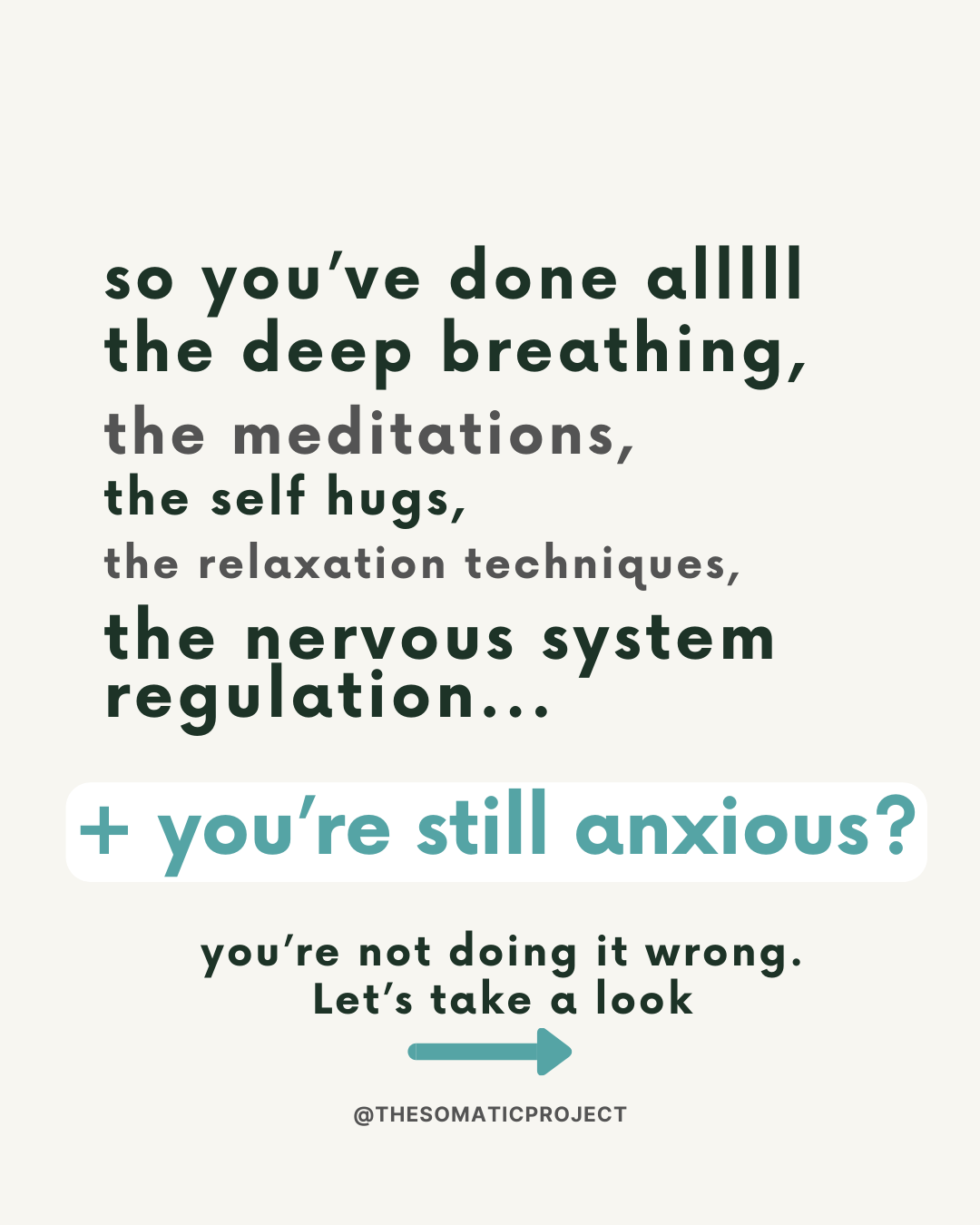
Many people try all the breathing exercises, grounding techniques and relaxation tools and still feel anxious or overwhelmed. This is because:
Regulation helps you feel safe, but it does not resolve what caused the threat response in the first place.
Anxiety is often not simply “too much activation”; it is unprocessed survival energy. The body is trying to complete something it never got to finish (Levine, 1997). A blocked fight or flight response. A protective action that was never expressed. A younger part of you that never felt met or supported (Fisher, 2017; Schwartz, 1995).
This is why nervous system work must include more than regulation. At The Somatic Project, we work with the three-step arc of Somatic Self Healing:
-
Regulation
Creating safety, grounding and stability in the body. Supporting the nervous system to settle so you can stay within your window of tolerance.
-
Processing
Working gently with the underlying survival energy through somatic techniques such as pendulation, titration, movement and micro-mobilisations (Levine, 1997; Payne, Levine and Crane-Godreau, 2015). This stage helps the body complete what was once incomplete.
-
Integration
Meeting the younger, frightened or protective parts of you with compassion. This involves somatic parts work, inner child work and relational repair internally (Schwartz, 1995; Fisher, 2017). Integration creates a sense of wholeness and belonging within yourself.
Regulation opens the door. Processing moves the energy. Integration changes the story.

Simple ways to begin nervous system regulation
Nervous system regulation does not need to be complicated. Small, consistent practices are more effective than intense interventions.
Softening your breath
Try keeping your exhale slightly longer than your inhale. This activates the parasympathetic system and invites settling (Brown and Gerbarg, 2005).
Orienting
Let your eyes move slowly around the space, taking in colours, light and shapes. This signals safety to the nervous system (Dana, 2018).
Vagal toning through sound
Humming, sighing or gentle vocalisation stimulates the vagus nerve and supports calm.
Slow, mindful movement
Gentle stretching, shaking, somatic yoga or walking help mobilise stuck activation.
Co-regulation
Connection with another safe person, animal or environment can regulate the system more quickly than solo practices (Porges, 2011).
Closing thoughts
Nervous system regulation is the foundation of trauma-informed healing. It helps the body rediscover safety, widens your window of tolerance and restores your capacity for presence and connection. But regulation is only the beginning.
When you combine regulation with somatic processing and compassionate integration, you create a pathway not just to coping, but to true transformation.
If you are ready to reconnect with your body, regulate your nervous system and begin healing from the inside out, our Somatic Self Healing programme offers step-by-step guidance rooted in science, compassion and lived experience.
Your body knows the way home. With the right support, you can learn to follow it.
References
Brown, R. P. and Gerbarg, P. L. (2005) ‘Sudarshan Kriya yogic breathing in the treatment of stress, anxiety, and depression: Part I neurophysiologic model’, Journal of Alternative and Complementary Medicine, 11(1), pp. 189–201.
Cohen, B. B. (2012) Sensing, Feeling, and Action: The Experiential Anatomy of Body-Mind Centering. Northampton, MA: Contact Editions.
Corrigan, F. (2014) Healing the Traumatized Self: Consciousness, Neuroscience, Treatment. New York: W. W. Norton & Company.
Dana, D. (2018) The Polyvagal Theory in Therapy: Engaging the Rhythm of Regulation. New York: W. W. Norton.
Fisher, J. (2017) Healing the Fragmented Selves of Trauma Survivors: Overcoming Internal Self-Alienation. New York: Routledge.
Hanna, T. (1988) Somatics: Reawakening the Mind’s Control of Movement, Flexibility, and Health. Reading, MA: Addison-Wesley.
Levine, P. A. (1997) Waking the Tiger: Healing Trauma. Berkeley, CA: North Atlantic Books.
Maté, G. (2003) When the Body Says No: The Cost of Hidden Stress. Toronto: Vintage Canada.
Ogden, P., Minton, K. and Pain, C. (2006) Trauma and the Body: A Sensorimotor Approach to Psychotherapy. New York: W. W. Norton.
Payne, P., Levine, P. A. and Crane-Godreau, M. A. (2015) ‘Somatic experiencing: Using interoception and proprioception as core elements of trauma therapy’, Frontiers in Psychology, 6, p. 93.
Porges, S. W. (2011) The Polyvagal Theory: Neurophysiological Foundations of Emotions, Attachment, Communication, and Self-Regulation. New York: W. W. Norton.
Schwartz, R. C. (1995) Internal Family Systems Therapy. New York: Guilford Press.
Schwartz, C. (2020) The Post-Traumatic Growth Guidebook. Boulder, CO: Sounds True.
van der Kolk, B. A. (2015) The Body Keeps the Score. New York: Viking.