Why you can't think your way out of anxiety
Have you ever known, logically, that everything is probably okay...yet you still feel anxious?
Perhaps you've reminded yourself that the meeting will probably go well, that your loved one is simply running late, or that you've done this presentation dozens of times before. Your rational mind understands there isn't a real danger, but your racing heart, tight chest and restless thoughts seem to have received a completely different message....?
If that sounds familiar, you're certainly not alone.
One of the most confusing parts of anxiety is that it often feels irrational. We can recognise that our thoughts are exaggerated, unrealistic or unlikely, yet still find ourselves unable to calm down. Many people begin to wonder whether they're simply overthinking too much or whether they just need to be stronger, more positive or better at controlling their thoughts.
For years, I believed exactly that.
I thought if I could just analyse my anxiety enough, understand where it came from, or find the right piece of advice, eventually it would disappear. Instead, I found myself trapped in a cycle of thinking about my thinking. The harder I tried to reason with anxiety, the louder it seemed to become.
It wasn't until I began learning about the nervous system that everything started to make sense.
Anxiety isn't simply happening in your thoughts. It is happening throughout your entire body.
Your brain, nervous system, breathing, muscles, hormones, heart rate and immune system all work together to keep you safe. When that protective system believes you're in danger, it changes the way you think, feel and behave. Understanding this completely changed the way I approached healing, and it is one of the reasons why Somatic Self Healing combines body-based practices with psychological understanding rather than treating them as separate approaches.
In this article we'll explore why anxiety cannot always be resolved through thinking alone, what is happening inside the brain and nervous system when anxiety takes over, why regulating the body often changes the mind, and how combining both approaches creates a safer and more effective path towards healing.
Table of contents
- Why can't I think my way out of anxiety?
- What actually happens in the anxious brain?
- Why logic disappears when anxiety takes over
- The body and mind work best together
- What CBT gets right, and where somatic approaches add something different
- How Somatic Self Healing approaches anxiety
- Conclusion
- References
Why can't I think my way out of anxiety?
The short answer is this:
Because anxiety is not simply a thinking problem.
While anxiety certainly affects our thoughts, its origins lie much deeper within the nervous system. Long before we consciously analyse a situation, our brain is already asking one very important question:
Am I safe?
This question is not answered by logic.
It is answered by the nervous system.
Every second of every day, your brain and body are continuously gathering information from both your internal world and your external environment. Without you consciously realising it, they are monitoring your breathing, heart rate, muscle tension, facial expressions, posture, previous experiences, the people around you and countless other signals to decide whether you are safe or whether you might need to protect yourself.
This process happens beneath conscious awareness through what Dr Stephen Porges calls neuroceptionYour nervous system's automatic process of detecting safety or danger without conscious awareness..
If neuroception detects enough cues of safety, your nervous system remains regulated. You can think clearly, stay present, connect with others and respond flexibly to whatever life brings.
If, however, your nervous system detects danger, whether that danger is real, remembered or simply perceived, it begins preparing your body for survival.
Your heart beats faster.
Your breathing changes.
Your muscles tighten.
Your attention narrows.
Your thoughts become focused on identifying and avoiding threat.
From an evolutionary perspective, this is incredibly intelligent.
Your brain is not trying to make you anxious.
It is trying to keep you alive.
The difficulty is that this protective system evolved to help us survive immediate physical threats. Today, many of the situations that activate anxiety are psychological or relational rather than life threatening. Financial worries, workplace stress, social rejection, perfectionism, uncertainty or past trauma may all activate exactly the same survival physiology as a physical danger would have done thousands of years ago.
This is why anxiety can feel so confusing; Your logical mind knows you're sitting safely in your office but your nervous system believes you're facing a threat. When these two systems disagree, the body almost always wins.
If you're unfamiliar with how the nervous system moves into survival states, you may also find it helpful to read my article explaining the fight or flight response, along with my guide to freeze and shutdown, as anxiety doesn't always present as high energy. Sometimes it looks like exhaustion, numbness or disconnection instead.
What actually happens in the anxious brain?
One of the reasons anxiety feels so convincing is because it changes how different parts of the brain communicate with one another.
When your brain perceives danger, a small almond-shaped structure called the amygdalaA part of the brain responsible for rapidly detecting potential danger and initiating survival responses. rapidly activates your body's survival response.
Within fractions of a second, stress hormones such as adrenaline and cortisol are released, increasing your heart rate, redirecting blood towards your muscles, sharpening your senses and preparing your body for action.
This all happens before you've consciously thought about what's happening.
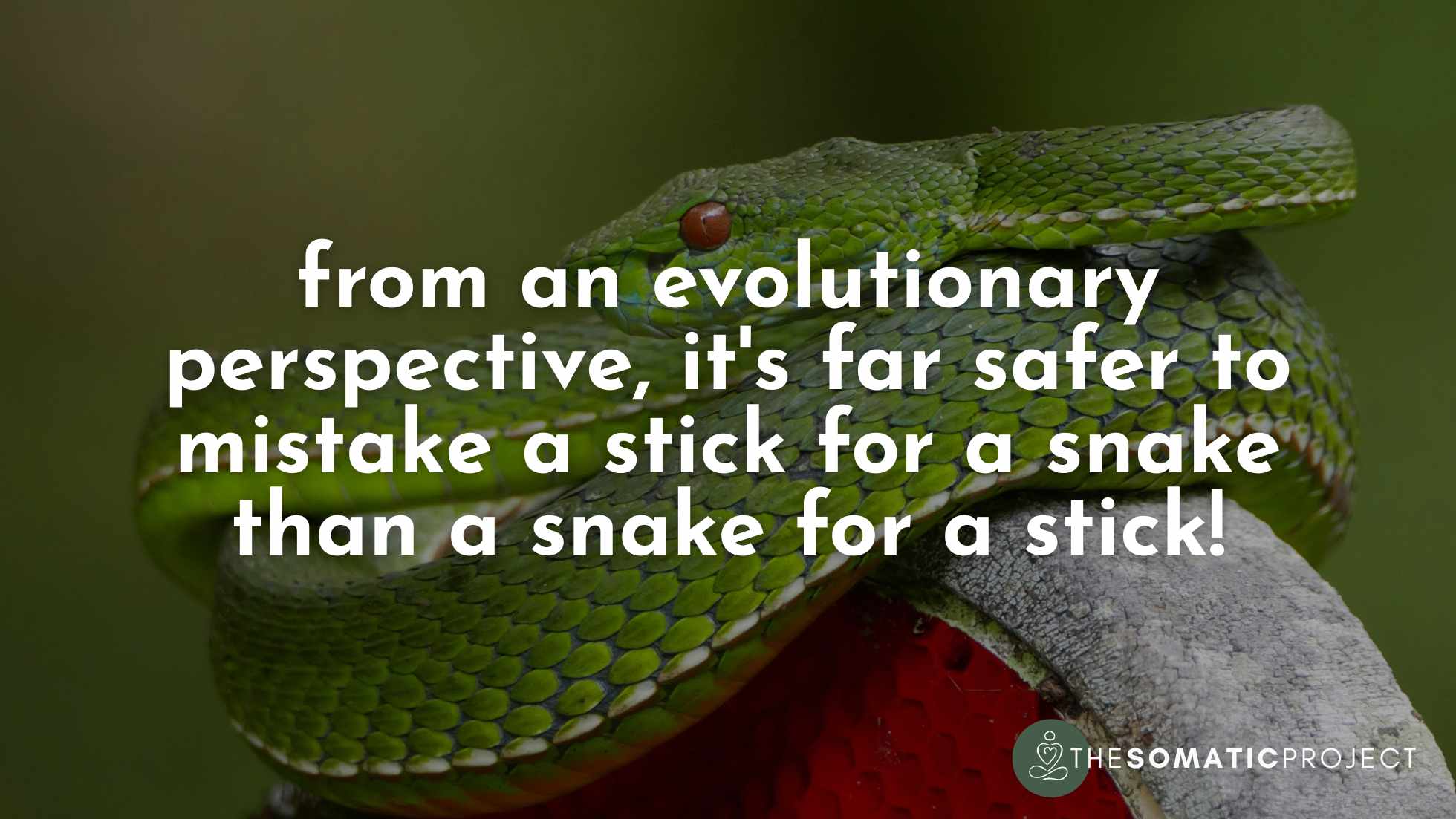
In fact, the amygdala is designed to prioritise speed over accuracy.... This is because from an evolutionary perspective, it's far safer to mistake a stick for a snake than a snake for a stick!
This means the anxious brain naturally becomes biased towards detecting potential danger, even when that danger turns out not to exist.
For people who have experienced chronic stress or trauma, this protective system often becomes even more sensitive over time. The nervous system learns from previous experiences and begins anticipating danger more quickly, making anxiety feel as though it appears out of nowhere.
This is one of the many reasons trauma can narrow our capacity to cope. If you'd like to explore this further, you might enjoy reading my article on the Window of Tolerance, which explains how chronic stress and trauma reduce the amount of activation our nervous system can comfortably process before entering survival states.
Why logic disappears when anxiety takes over
One of the questions I'm often asked is: "If I know I'm safe, why do I still feel anxious?"
The answer lies in another remarkable part of the brain: The prefrontal cortexThe part of the brain involved in logical thinking, planning, emotional regulation, empathy and decision making. helps us weigh up evidence, solve problems, regulate emotions and think flexibly.
When we're calm, this part of the brain works beautifully, but when survival physiology becomes activated, access to the prefrontal cortex reduces while survival networks become prioritised.
In simple terms, your brain temporarily shifts from asking: "What's the most logical explanation?" to asking "How do I survive this?"
This is why anxious thoughts often feel impossible to argue with; you might tell yourself that your presentation will probably go well, but your body continues trembling. Or you might remind yourself that your partner still loves you, yet you continue fearing rejection. Or you might know statistically that flying is safe, while your body behaves as though you're in immediate danger.
Now, this isn't because you're irrational - it's because your nervous system is currently speaking louder than your logical mind. It's intelligent rather than irrational! And I believe that understanding this can be deeply compassionate.
It reminds us that anxiety is not a lack of intelligence, but it is a protective nervous system doing exactly what it has learned to do.
The encouraging news is that once we begin working with the nervous system itself, something interesting happens. As the body begins to feel safer, the mind often becomes quieter without us forcing it to.
In the next section, we'll explore why body-based regulation changes the way we think, why this doesn't mean psychological approaches are unhelpful, and why combining the body and the mind often creates the most effective and lasting approach to healing anxiety.
The body and mind work best together
At this point you might be wondering if anxiety changes the way we think, does that mean thinking doesn't matter? And I've noticed in some of the somatic content I see online there can be a tendency to discount the mind, or more psychological approaches which work with thoughts... but this isn't the case.
Our thoughts absolutely influence our emotions, behaviours and nervous system. The stories we tell ourselves shape the way we experience the world, and psychological therapies such as Cognitive Behavioural Therapy (CBT) have helped millions of people develop healthier thinking patterns and improve their wellbeing.
The challenge is not that thinking is unhelpful....the challenge is that anxious brains often struggle to access their best thinking while the nervous system still believes it is under threat.
Imagine trying to have a calm, rational conversation with someone while a fire alarm is ringing beside your head? Technically you could still talk, but your attention would constantly be pulled back towards the alarm and your body would remain alert. You would probably struggle to concentrate fully on the conversation! An anxious nervous system works in much the same way.
As long as your brain continues receiving signals that suggest danger, survival physiology remains the priority. This makes logical thinking much harder to access, not because you've suddenly become less intelligent, but because your brain is allocating its resources towards protection instead of reflection and reason.
This is one of the reasons I love learning about the nervous system, and why I find it so deeply compassionate: It replaces self-blame with understanding.
If you've ever found yourself thinking:
"Why can't I just stop worrying?"
or
"I know these thoughts don't make sense, so why can't I let them go?"
The answer may not be that you're failing to think clearly. It may simply be that your nervous system doesn't yet feel safe enough to allow clearer thinking to emerge. This is where body-based approaches become so valuable.
Rather than beginning by trying to change anxious thoughts, we first begin changing the physiological state that is creating those thoughts.
When breathing slows, muscle tension softens, heart rate settles and the nervous system begins detecting cues of safety again, the brain naturally starts functioning differently.
Very often, thoughts that felt overwhelming a few minutes earlier begin losing their intensity without us forcing them to disappear. This doesn't mean the body replaces the mind. It means the body and mind work together.
In fact, one of the fascinating things about the vagus nerveThe main nerve of the parasympathetic nervous system, helping regulate heart rate, breathing, digestion and feelings of safety. is that around 80% of its nerve fibres carry information upwards from the body to the brain, while only around 20% carry messages downwards from the brain to the body. In other words, the brain is constantly listening to the body before deciding how safe the world feels.
If you'd like to understand this in more detail, you may enjoy reading my article on the vagus nerve, where I explain why body-based practices can have such a powerful effect on anxiety and emotional wellbeing.
What CBT gets right, and where somatic approaches add something different
Sometimes body-based approaches and CBTCognitive Behavioural Therapy (CBT) is a talking therapy that helps people recognise and change unhelpful patterns of thinking and behaviour that contribute to emotional distress. are presented as though they're competing with one another; I don't believe they are, or that they need to be as they both have something valuable to offer.
CBT teaches us to become aware of the relationship between our thoughts, feelings and behaviours. It helps us notice cognitive distortions, question assumptions and develop more balanced ways of interpreting our experiences.
These are incredibly useful skills. But many people discover something frustrating when anxiety is particularly strong....
You might know exactly what your therapist would encourage you to think, you know your anxious thoughts probably aren't accurate, you understand the evidence, yet you still feel anxious. I know how frustrating this can feel - I've been there!
But this isn't because your thinking has failed, it's because there are moments when the nervous system needs tending to before those cognitive skills become fully accessible. CBT tries to reason before regulation....
Within Somatic Self Healing, I often describe this as Regulation before Reason.
Rather than beginning with the question:
"How can I change this thought?"
we begin by asking:
"What is my nervous system experiencing right now?"
Perhaps your chest feels tight?
Your shoulders have crept towards your ears?
Your breathing has become shallow?
Your jaw is clenched?
These are not simply symptoms to ignore - They are information, telling us what state the nervous system is currently in.
In Somatic Self Healing, instead of immediately challenging anxious thoughts, we first respond to those signals through gentle regulation.
That might involve slowing the breath.
Feeling your feet against the floor.
Softening tension through movement.
Using a supportive self-hold.
Orienting to your surroundings.
Or any of the many nervous system regulation practices that help your body detect safety again.
Only then do we revisit our thinking... and often we can then access that much more logical and rational part of our brain.
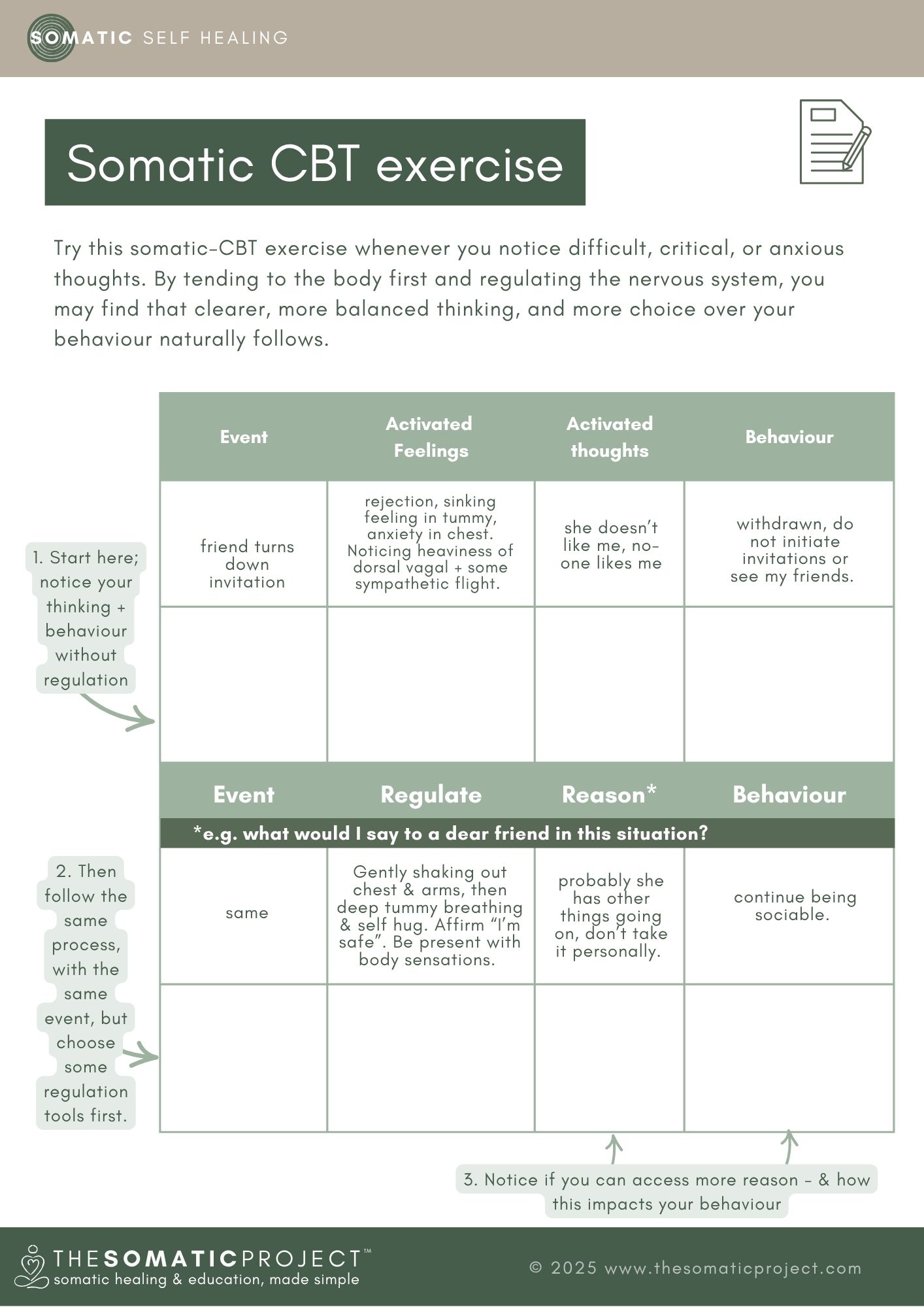
One of the exercises inside Somatic Self Healing combines these approaches in what I call a Somatic CBT exercise. Here's it in action:
- Imagine a friend declines your invitation to meet. If your nervous system is already anxious, your thoughts might immediately become:
"They don't like me."
"Nobody wants to spend time with me."
You might withdraw, stop messaging people or isolate yourself.
- Now imagine approaching exactly the same situation differently.
Before analysing the thoughts, you gently shake out your arms and shoulders, take several slow diaphragmatic breaths, place a hand over your heart, remind yourself "I'm safe", and simply notice the sensations moving through your body.
- Nothing about the situation has changed. Your friend still declined the invitation. But often, something inside you has changed. Once the nervous system settles, many people naturally find themselves thinking something closer to:
"Perhaps they're just busy."
"This probably isn't about me."
"I'll ask them again another time."
The thinking didn't change because you forced yourself to believe something positive.
It changed because your nervous system no longer believed you were in immediate danger.
This beautifully reflects the work of psychiatrist Dr Bruce Perry, whose sequence of Regulate → Relate → Reason reminds us that meaningful reflection becomes far more available once the nervous system has first experienced regulation.
Rather than choosing between body or mind, Somatic Self Healing brings the two together. We regulate the body so the mind can access its natural capacity for perspective, curiosity and choice.
Because when the nervous system begins to feel safe again, clearer thinking often follows naturally.
If you would like to try a somatic CBT exercise yourself, you can follow this process on this worksheet. Download the .pdf here.
So what actually helps anxiety?
If anxiety isn't simply a thinking problem, then healing isn't simply about thinking differently.
That doesn't mean insight isn't valuable, as understanding ourselves can be incredibly empowering. Learning about anxiety, trauma and the nervous system often helps us realise that what we're experiencing makes sense. Many people tell me that simply understanding why their body responds the way it does is the first time they've stopped feeling broken.
But insight alone rarely changes physiology...
You can remind yourself that your partner isn't angry with you and still feel your stomach tighten after reading a short text message.
This is because the nervous system changes through experience, not information alone.
One of the remarkable things about the brain and nervous system is that they remain capable of change throughout life. This ability is known as neuroplasticityThe brain and nervous system's ability to change and reorganise through repeated experiences, learning and practice..
Just as repeated experiences of stress, unpredictability or trauma can teach the nervous system to expect danger, repeated experiences of safety can gradually teach it something new.
This is why nervous system healing isn't about convincing yourself you're safe: It's about helping your body experience safety often enough that it begins to believe it.
This is also why healing is rarely a single breakthrough moment.
It is usually hundreds of small moments.
- A slower exhale.
- A shoulder softening.
- Feeling your feet on the floor.
- Allowing yourself to receive support from another person.
- Choosing curiosity instead of self-criticism.
Each of these experiences becomes new information for the nervous system. Which over time, these experiences begin changing what your brain predicts about the world. This is why practices that involve the body can feel surprisingly powerful, even though they may appear incredibly simple. This might include:
- Breathwork.
- Grounding.
- Gentle movement.
- Orienting.
- Self-holds.
- Resourcing.

They aren't simply relaxation techniques. They are helping your nervous system gather evidence that this moment is different from the moments it has spent so long preparing to survive.
If you're new to this way of understanding anxiety, you may find my articles on nervous system regulation, the vagus nerve and the Window of Tolerance helpful companions to this one.
Why Somatic Self Healing takes a three-stage approach
One of the biggest misconceptions about healing anxiety is that we should dive straight into the difficult feelings.
Many people have heard phrases like "feel it to heal it," and there is truth in that...At some point, healing does involve turning towards the emotions, sensations and memories we've spent years avoiding.
But there is a very important part of that sentence that often gets left out: We first need the capacity to feel them safely.
This is why Somatic Self Healing follows a gradual, skills-based journey rather than encouraging people to relive overwhelming experiences before their nervous system is ready.
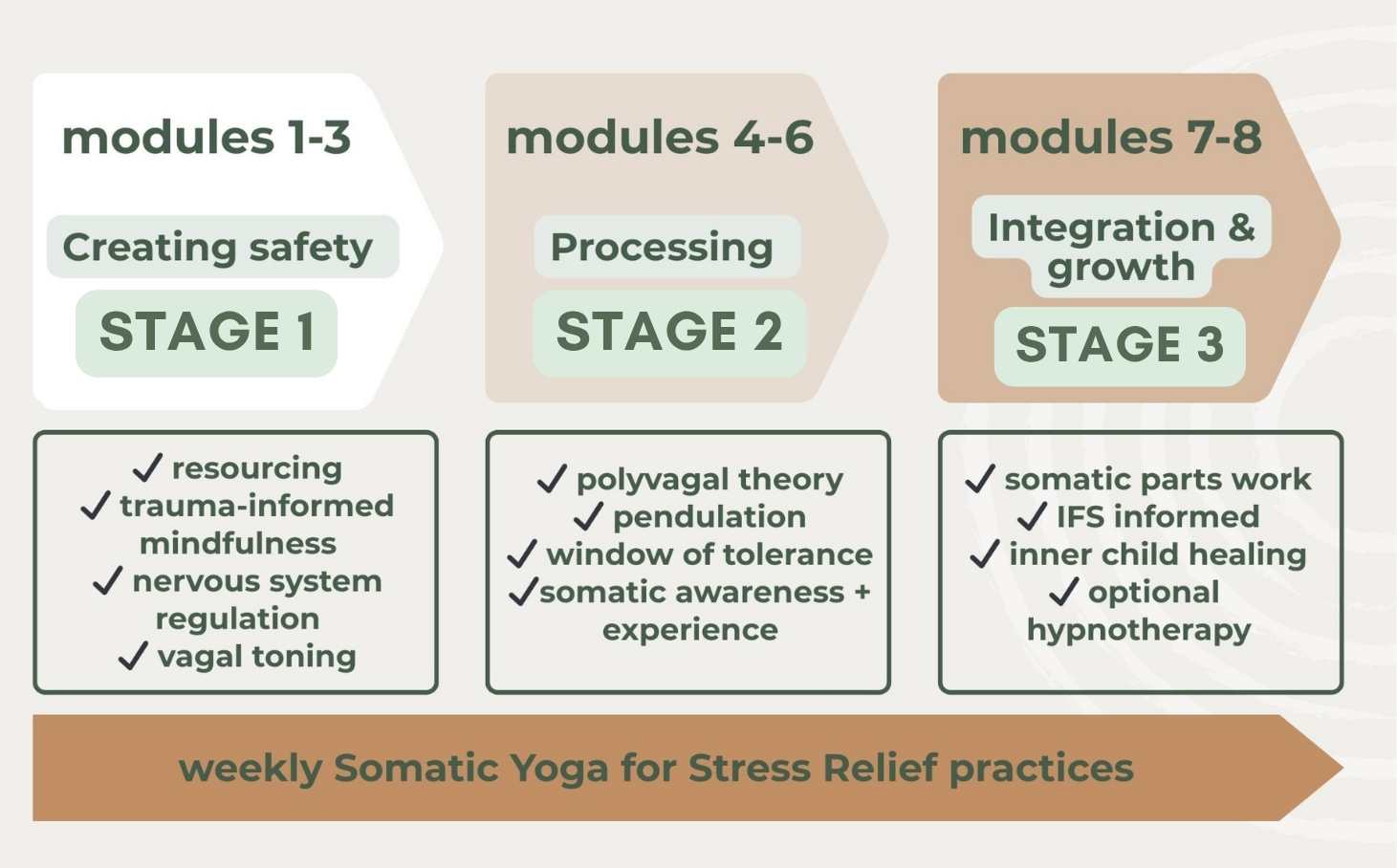
The first stage focuses on creating safety and regulation.
We learn how to recognise nervous system states, understand what anxiety feels like in the body, build resources, strengthen the vagus nerve and develop practical skills that help us return towards steadiness.
The second stage introduces gentle processing.
Rather than opening the floodgates, we approach difficult sensations gradually, working within the body's Window of Tolerance. Using approaches such as pendulation and titration, we allow small amounts of activation to arise before returning to regulation. In this way the nervous system learns that difficult emotions can be experienced without becoming overwhelmed.
The final stage is integration.
This is where those experiences begin finding their place within the wider story of our lives. We develop greater self-compassion, work with protective parts of ourselves, and gradually replace survival-driven patterns with greater flexibility, choice and resilience.
Notice that nowhere in this process are we trying to force anxiety to disappear. Instead, we are helping the nervous system become so much more adaptable that anxiety no longer needs to dominate our lives. And then, as safety grows, clearer thinking often follows naturally.
Rather than trying to think our way into feeling safe, we begin feeling safe enough to think clearly again.
The three stages of Somatic Self Healing:
Conclusion: You don't need to think harder
If you've spent years trying to think your way out of anxiety, I hope this article has helped you understand why that can feel so exhausting.
It isn't because you're doing it wrong!
And it certainly isn't because you simply haven't found the right positive thought yet.
Anxiety is not just happening in your mind. It is happening throughout your whole nervous system.
Your thoughts, emotions, breathing, posture, heart rate, muscle tension and patterns of attention are all working together as part of one beautifully intelligent system whose primary job is to keep you alive.
If that system has learnt, through chronic stress, trauma or repeated overwhelm, that the world feels unpredictable or unsafe, it makes complete sense that your mind keeps searching for danger. Worry, overthinking and rumination are often your brain's attempt to protect you, even when those strategies no longer serve you.
The encouraging news is that the nervous system is not fixed or rigid... Just as it learnt these protective patterns, it can gradually learn new ones. This is why healing is not about fighting your anxiety or trying to silence every anxious thought but about helping your body experience enough safety that your brain no longer needs to work so hard to protect you.
Sometimes that might begin with a slower breath.
These moments may seem small, but repeated over time they become powerful. Every time your nervous system experiences safety, connection, curiosity or compassion, it gathers new evidence about the world. That is how neuroplasticity works. That is how resilience grows.
Healing happens through small, repeated experiences of safety that gradually widen your capacity to meet life with greater flexibility and ease.
References
- Beck, J.S. (2020) Cognitive Behavior Therapy: Basics and Beyond. 3rd edn. New York: Guilford Press.
- Fisher, J. (2021) Healing the Fragmented Selves of Trauma Survivors: Overcoming Internal Self-Alienation. 2nd edn. New York: Routledge.
- Herman, J.L. (1992) Trauma and Recovery: The Aftermath of Violence, From Domestic Abuse to Political Terror. New York: Basic Books.
- Levine, P.A. (2010) In an Unspoken Voice: How the Body Releases Trauma and Restores Goodness. Berkeley, CA: North Atlantic Books.
- Perry, B.D. and Winfrey, O. (2021) What Happened to You? Conversations on Trauma, Resilience, and Healing. New York: Flatiron Books.
- Porges, S.W. (2011) The Polyvagal Theory: Neurophysiological Foundations of Emotions, Attachment, Communication, and Self-Regulation. New York: W.W. Norton & Company.
- Siegel, D.J. (2020) The Developing Mind. 3rd edn. New York: Guilford Press.
- van der Kolk, B.A. (2014) The Body Keeps the Score: Brain, Mind, and Body in the Healing of Trauma. New York: Viking.