Somatic exercises for anxiety: 7 gentle practices to try at home

When you're wound up, on edge or a little far away from yourself, your body can often help you find your way back faster than your thoughts can. Here are seven gentle somatic exercises for anxiety you can try at home in a few minutes, and why they work.
Table of contents
Introduction
When I teach these practices in workshops, there's a moment I love. Someone tries the voo breath for the first time, makes a slightly ridiculous foghorn noise, laughs, and then goes quiet. A minute later they say something like, "Oh, I feel calmer, and I notice my shoulders have dropped."
That's the whole point of somatic work. You don't have to believe it or understand it for it to help. Your body notices first.
Here are seven practices I come back to again and again, with myself and with the people I work with, most of them from inside Somatic Self Healing. They take a few minutes, and you don't need to do them all. Pick one, try it, and notice what your body says.
What are somatic exercises?
"Soma" means the body as we experience it from the inside. Somatic exercises use breath, sound, movement, touch and awareness to help your nervous system move out of survival mode and back towards safety.
They work from the bottom up. Most of the fibres in your vagus nerveA long nerve running from your brainstem to your gut that helps regulate heart rate, breathing, digestion and your sense of safety. carry messages from the body up to the brain, so your brain is constantly listening to your body before it decides how safe the world feels (Porges, 2011). This is sometimes called a bottom-upApproaches that start with the body (breath, movement, sensation) to change how you feel, rather than starting with thoughts. Talking therapies are usually top-down. approach. Change the signals coming up from the body, and you change the message the brain receives.
I call this regulation before reason. We help the body settle first, and clearer thinking tends to follow. It's why you can't think your way out of anxiety.
Where anxiety can show up
How anxiety can feel in your body
Or anywhere: feeling hot and sweaty, trembling, tingling or numbness, jumpy and on edge, or tired but wired.
Everyone's mix is different. Find out which state your body leans towards.
7 somatic exercises for anxiety
1. Butterfly taps
Cross your arms over your chest so your fingertips rest just below your collarbones, like a butterfly's wings. Tap slowly, left then right, at whatever pace feels soothing. Breathe as you are, and keep going for a minute or two, or until something softens.
Butterfly taps
Arms crossed, hands resting below your collarbones. Tap slowly, one side then the other.
1 to 2 minutes
Butterfly taps, often called the butterfly hug, were developed by therapists supporting children after a hurricane in Mexico in the late 1990s (Artigas and Jarero, 2014). The slow, rhythmic left and right touch is something many nervous systems find steadying, and you can do it almost anywhere. It's in Module 2 of Somatic Self Healing as a guided video.
2. Hummingbee breath
Breathe in gently through your nose. With your lips softly closed, breathe out slowly while making a low hum, like a bee. Let the hum last as long as the out-breath does, then breathe in again. Five or six rounds. If you like, rest your index fingers on the little flaps at the front of your ears, so the sound feels bigger on the inside.
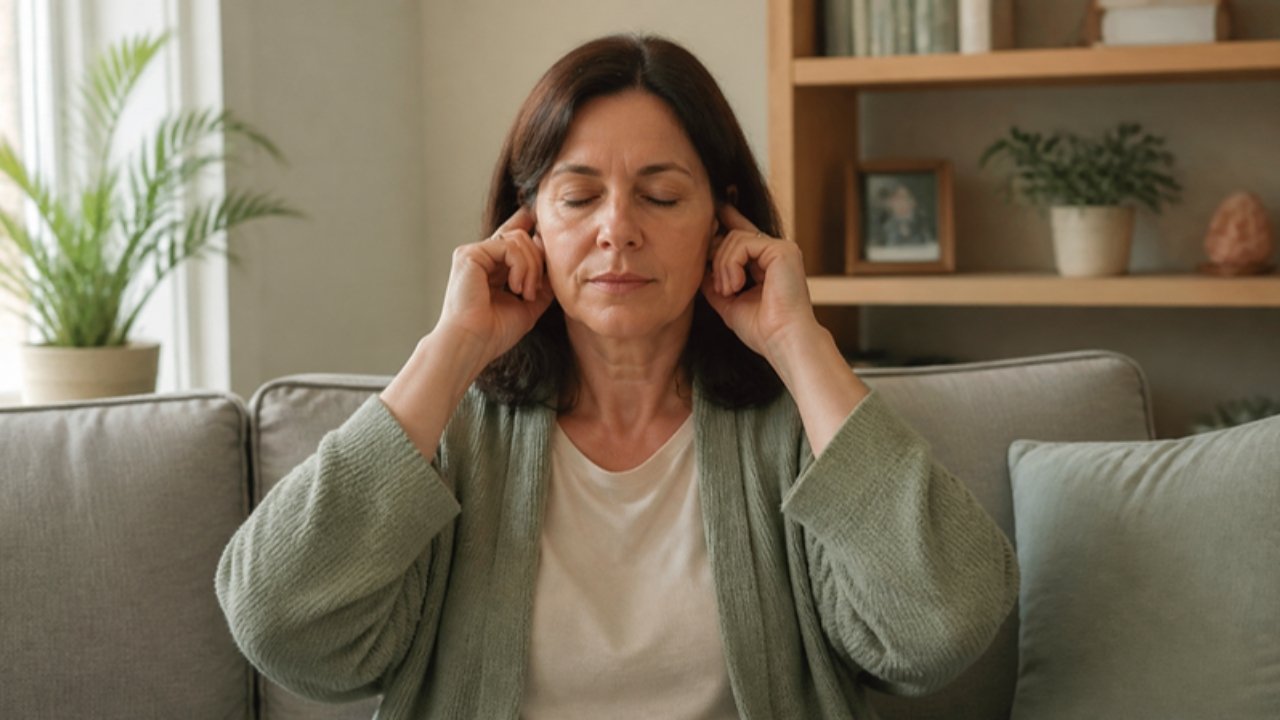
This one comes from yoga, where it's called bhramariA traditional yoga breath where you hum softly on a long out-breath.. Humming naturally makes your out-breath longer than your in-breath, which is one of the simplest ways to let your nervous system know it can ease off, and many people find the vibration in the face and chest soothing in itself. There's a guided Hummingbee Breath in Module 2.
3. Focal shifting
Hold one thumb up about a hand's length in front of your face and let your eyes rest on it. Then look past it to something far away, out of a window if you can. Move slowly between near and far, five to ten times, and finish on the far point, letting your gaze go soft and wide.
Focal shifting
Near, then far, then near again
Look at your thumb, then at something far away.
5 to 10 times, ending far
When we're anxious, our focus tends to narrow onto whatever feels threatening, a bit like tunnel vision. Gently widening it again reminds your eyes, and the nervous system behind them, that there's more here than the worry. There's a guided Focal Shifting video in Module 2.
4. A safe place
Bring to mind somewhere you feel at ease. It can be real or imagined: a beach, a favourite chair, a walk you love. Notice the colours, the sounds, the temperature of the air. Then notice where in your body you can feel that ease, even a little, and stay with it for a few breaths.

Your nervous system responds to what you imagine as well as what's in front of you, which is why a worry can set your heart racing. This practice uses the same pathway the other way round. If no place comes, that's okay. A pet, a person or the warmth of a mug in your hands works just as well, and you can keep your eyes open. There's a guided Safe Space Visualisation in Module 1.
5. Pushing into a wall
Stand facing a wall, palms on it at shoulder height. Push slowly, as though you could move it, for a count of five. Feel your hands, arms, shoulders and back switch on. Release on an out-breath and shake out your hands. Three times.
Pushing into a wall
Push for five, let go on the out-breath
Palms on the wall at shoulder height. Push slowly, then release and shake out your hands.
3 times
When anxiety leaves you tense and on edge, the body is often primed for action that never happens. Pushing completes a little of that cycle. There's a whole practice built around it, Pushing into the Wall, in Module 5.
6. The shake out
Shake your hands loosely for thirty seconds, then your arms, then let your knees bounce so your whole body jiggles. Loose jaw. Then stop and notice the tingle.

Animals do this naturally after a stressful encounter, shaking off the activation before going back to grazing (Levine, 1997). We tend to hold it in instead. A gentle shake gives the body permission to dischargeLetting built-up survival energy move through and out of the body, often through shaking, sighing, yawning or trembling. some of it. The longer guided version, the Somatic Shake Out, is in Module 5.
7. Feel your feet
Press your feet into the floor. Notice the ground holding you. Rock a little from heels to toes. You can do this under a desk, on a train or in a difficult meeting, and nobody will know.
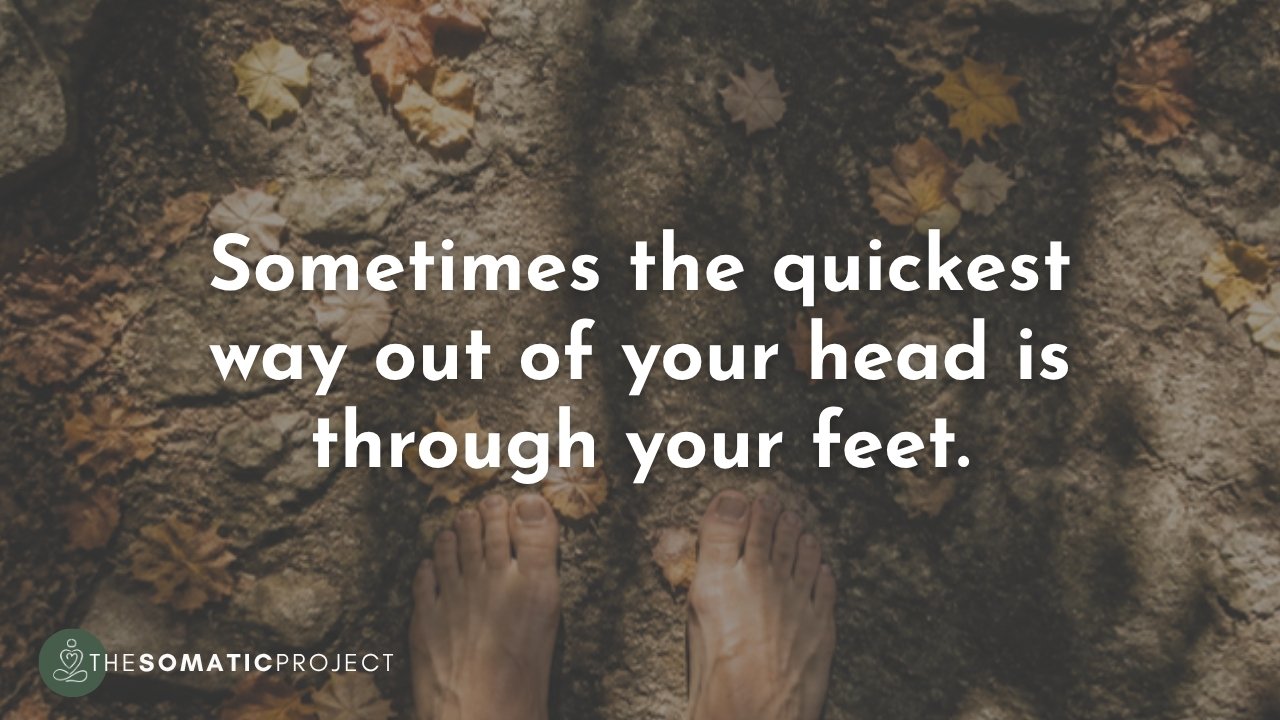
When anxiety pulls us up into our heads, our feet bring us back down. Sometimes the quickest way out of your head really is through your feet. Module 1 has a longer guided practice built on this sense of where your body is, Somatic Resourcing: proprioception.
Finding the practice that suits you
Seven practices is a lot to choose from, and the one that helps most depends on the state your body is in. That's what my free check-in is for. It takes about 10 seconds, and it sends you a short guide and five days of practices in the order that suits your state.
Let your body choose
Find out which state your body is in today
Take the free check-inFree, and it opens in a new tab so you won't lose your place.
When you've found your state, come back to the practices above, and read on for a few simple ways to get the most from them.
How to get the most from these practices
- Practise when you're okay, not only when you're anxious. A skill is much easier to reach for in a hard moment if your body already knows it.
- Go slowly. Somatic work is about noticing, not performing.
- Look for small signs. A softer breath, a shoulder dropping, a sigh or a yawn. These are your nervous system saying "that helped".
- Stop if something doesn't feel right. Not every practice suits every body. Your body is the guide.
The aim isn't to feel calm all the time, by the way. Nervous systems aren't designed for that. The aim is to move through the ups and downs a little more easily, and come back to steady ground more often.
When more support is needed
These practices help with everyday anxiety and stress, but they aren't a replacement for professional support. If your anxiety is severe, linked to trauma or getting in the way of daily life, please speak to your GP or a trauma-informed therapist alongside any self-help.
Going deeper
If you'd like these practices and many more in a structured, gentle journey, Somatic Self Healing brings them together across eight modules you can follow at your own pace, from safety and regulation through to releasing stored tension and meeting each survival state.
"Your course material has been exceptionally clear and accessible. The practices are wonderful. I have really valued the wide range of practices you have offered, as this has allowed me to draw on those that help me most in different circumstances."
Questions people often ask
How quickly do somatic exercises work for anxiety?
Some, like a long hummed out-breath, can shift how you feel within a minute or two. Longer-term change comes from practising little and often, so your nervous system builds a new baseline.
Can I do somatic exercises at work?
Yes. Feeling your feet, focal shifting and small butterfly taps with your hands resting on your upper arms can all be done at a desk or in a meeting without anyone noticing.
What if a practice makes me feel worse?
Stop, open your eyes, and feel your feet on the floor. Not every practice suits every body or every day. Try a different one, or go even smaller.
We're currently supporting
1,649
people with somatic healing
as of November 2026


Written by Claire Sankey
Integrative somatic therapist and founder of The Somatic Project. Fully certified and insured, with specialist training in somatic trauma therapy, applied polyvagal theory and complex trauma. Claire has worked one to one and with groups, and with the military, medical professionals, charities and ITV.
References
- Artigas, L. and Jarero, I. (2014) 'The Butterfly Hug', in Luber, M. (ed.) Implementing EMDR Early Mental Health Interventions for Man-Made and Natural Disasters. New York: Springer.
- Levine, P. A. (1997) Waking the Tiger: Healing Trauma. Berkeley, CA: North Atlantic Books.
- Porges, S. W. (2011) The Polyvagal Theory. New York: W. W. Norton.